

If your calendar already feels like a wall of repeating blocks, weekly check-ins, monthly reviews, and recurring status calls, you’re not alone. Many professionals struggle with recurring meetings that continue out of habit rather than purpose, leading to repetitive discussions, declining engagement, and wasted time.
A recurring meeting should create structure and alignment, not frustration. When planned correctly, these scheduled meetings help teams track progress, make decisions faster, and maintain consistent communication.
This guide explains why recurring meetings often fail, how to structure them effectively, and how to plan a recurring meeting that actually works. By the end, you’ll know how to design meeting series that improve team performance instead of draining productivity.
Contents
- 1 What Is a Recurring Meeting?
- 2 Types of Recurring Meetings
- 3 Benefits of Recurring Meetings
- 4 Recurring Meeting vs Reoccurring Meeting: What’s the Difference?
- 5 Why Recurring Meetings Fail More Often Than You Think
- 6 Recurring Meeting Planning Framework: How to Make Them Work
- 7 How Often Should You Schedule a Recurring Meeting?
- 8 Managing Meeting Series: Series vs Occurrence Explained
- 9 Recurring Meetings in Hybrid & Remote Teams
- 10 How Automation Can Improve Every Recurring Meeting
- 11 How Meeting Room Booking Software Supports Recurring Meetings
- 12 When to Cancel, Reduce, or Rebuild a Recurring Meeting
- 13 Templates for Effective Recurring Meetings
- 14 Final Thoughts And How to Make Every Recurring Meeting Run Smoothly
- 15 FAQs: Recurring Meeting
- 15.1 What is a recurring meeting?
- 15.2 Why do recurring meetings become ineffective over time?
- 15.3 How often should you schedule a recurring meeting?
- 15.4 What’s the difference between a recurring and a reoccurring meeting?
- 15.5 How can you make recurring meetings more productive?
- 15.6 When should you cancel or redesign a recurring meeting?
What Is a Recurring Meeting?
When people ask, “What is a recurring meeting?” The answer is simpler than they expect. A recurring meeting is one that automatically repeats on a schedule, daily, weekly, monthly, or quarterly. Put simply, a recurring meeting is an event that repeats routinely based on a preset frequency.
Common examples include:
- Weekly check-ins
- Monthly team meetings
- Sprint reviews
- Quarterly planning sessions
These meeting room software exist to create consistency, something most teams need, but only if they’re structured well.
Types of Recurring Meetings
Recurring meetings are scheduled meetings that happen regularly to maintain team alignment, track progress, and support decision-making. Different meeting types serve different purposes depending on the team’s workflow and business goals.

Here are seven of the most common types:
- Weekly recurring meeting for operations updates
- Monthly team meetings for department-wide announcements
- Monthly meetings with employees for performance alignment
- Recurring call with external partners or clients
- Bi-weekly sprint reviews
- Quarterly planning and forecasting meetings
- Weekly leadership syncs
Benefits of Recurring Meetings
The benefits of recurring meetings come from creating a consistent structure for communication, decision-making, and progress tracking. When scheduled with a clear purpose, recurring meetings help teams stay aligned, accountable, and focused on shared goals.
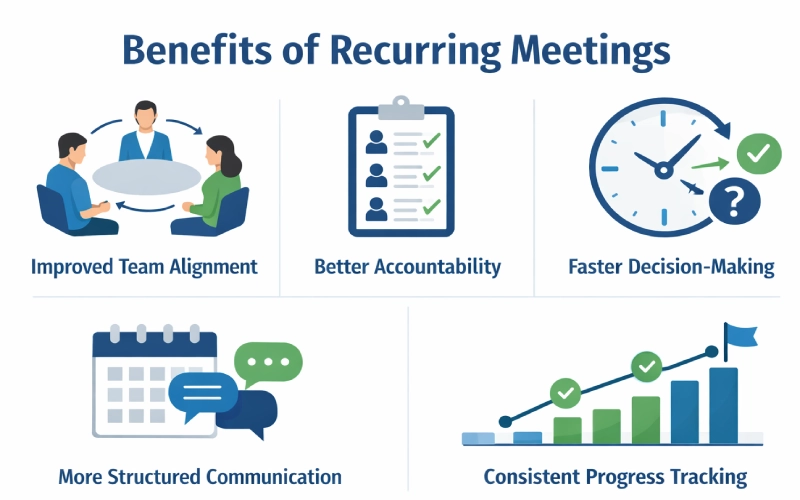
- Improved team alignment
Regular meetings keep everyone informed about priorities, project updates, and shared goals. This reduces misunderstandings and keeps teams moving in the same direction.
- Better accountability
When meetings occur on a consistent schedule, team members are more likely to prepare updates and follow through on assigned tasks. This helps maintain responsibility for progress and outcomes.
- Faster decision-making
Recurring meetings provide a predictable space to discuss issues and resolve blockers quickly. Instead of waiting for ad-hoc discussions, teams can address problems during the next scheduled session.
- More structured communication
A regular meeting cadence prevents scattered conversations across emails or chat tools. Teams know when and where discussions will happen, which improves collaboration. In addition, some teams now create AI-generated avatars to standardize communication delivery across updates and training materials.
- Consistent progress tracking
Recurring meetings create natural checkpoints for reviewing work, measuring performance, and adjusting plans when needed. This keeps projects on track and aligned with business objectives.
Recurring Meeting vs Reoccurring Meeting: What’s the Difference?
Many people search for “recurring” or “reoccurring” meetings because the terms sound similar. However, only “recurring” is correct in professional usage.
✔ Recurring = happens repeatedly on a schedule
✖ Reoccurring / reoccuring / reoccurring/reoccurring = happens again, but not necessarily on a schedule
Use “recurring meeting” when writing professionally, particularly in calendar invites, automated reminders, and email notifications where clarity improves email deliverability and engagement.

Examples using each spelling:
- Recurring meeting: “Our recurring meeting happens every Monday.”
- Recurring meeting: “This issue has been recurring lately.”
- Recurring meeting: “If a recurring meeting appears on your calendar, check the spelling.”
- Recurring meeting: “A recurring meeting is simply one that happens again.”
- Recurring meeting: “A recurring meeting may or may not follow a routine schedule.”
Why Recurring Meetings Fail More Often Than You Think
Even though recurring meetings are meant to bring clarity, they often become unproductive. They fail because:
- No one revisits the purpose.
- Agendas are nonexistent.
- Too many attendees are invited.
- The frequency becomes misaligned with actual needs.
- Scheduling overlaps create friction.
Research across organisations consistently shows that unstructured recurring meetings account for some of the most wasted work hours.
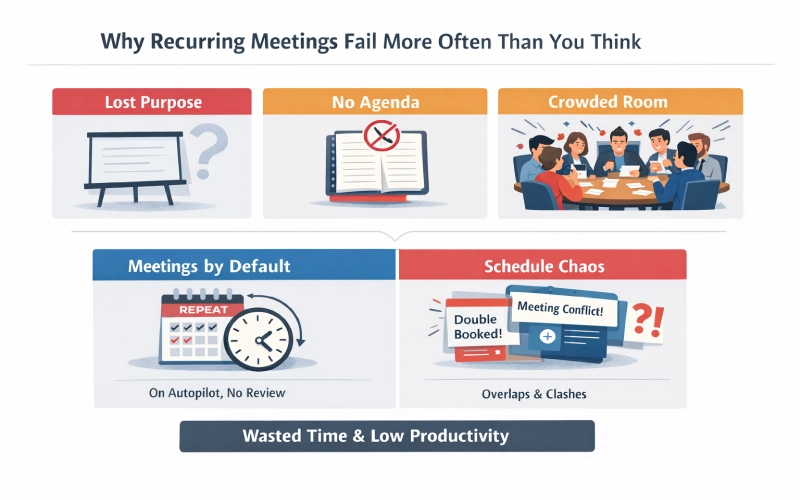
Meetings That Continue “By Default”
This is one of the biggest reasons recurring meetings lose value. Once created, they continue indefinitely long after their purpose has faded.
A simple 2-step fix:
- Review every recurring meeting monthly or quarterly.
- Confirm if this meeting still drives decisions or outcomes?
If not, then it is time to cancel, reduce, or redesign it.
Too Many Attendees, Not Enough Outcomes
Indeed, it is a fact that inviting too many people leads to:
- Cognitive overload
- Secondary talks
- Dispersed liability
Rule of thumb:
Invite exclusively decision-makers and direct contributors. All others are eligible for notifications later.
Calendar Conflicts and Poor Scheduling
Teams commonly come across:
- Simultaneous meetings
- Rooms with double bookings
- Incorrect room sizes
- Substandard scheduling
These difficulties are intensified, particularly in dynamic offices where room booking conflicts occur regularly.
Recurring Meeting Planning Framework: How to Make Them Work
A recurring meeting planning framework is a structured approach used to design and manage effective recurring meetings, so they remain purposeful and productive. By defining the meeting’s purpose, frequency, duration, agenda, and roles, teams can ensure that recurring meetings consistently support collaboration and decision-making.
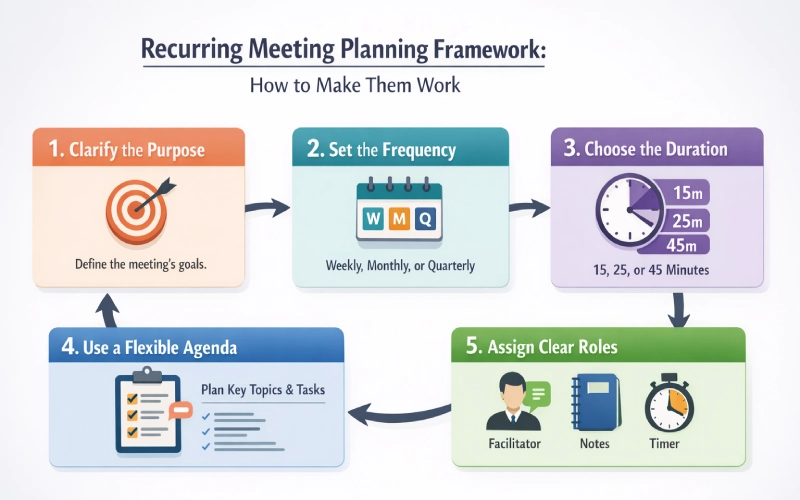
Step 1: Clarify the Purpose of the Recurring Meeting
Establish the central arguments.
At the end of each weekly operations meeting, we must determine the three primary priorities for the following seven days.
If the meeting does not achieve its purpose, adjust or break it down frequently.
Step 2: Set the Perfect Frequency (Weekly, Monthly, Quarterly)
Select the frequency of your meetings based on urgency and workflow.
- Weekly: dynamic teams (agile, operations, marketing)
- Monthly: strategic alignment and performance evaluation
- Quarterly: significant planning cycles, objective realignments
This helps mitigate over- or underscheduling while also ensuring efficient and consistent communication.
Step 3: Choose the Right Duration
Suggested duration:
- 15 minutes for status updates.
- 25 minutes allocated for alignment discussions.
- 45 minutes allocated for in-depth problem resolution.
Brief interactions enhance concentration and diminish cognitive tiredness.
Step 4: Use a Flexible Agenda Template
Incorporate 3 to 5 fundamental agenda points, such as:
- Urgent updates
- Essential determinations required
- Obstacles to address
- Evaluation of metrics
- Tasks to be completed
This maintains conversations that are both organised and flexible.
Step 5: Assign Clear Roles
Each recurring meeting must include:
- Facilitator
- Record Keeper
- Timetaker
These positions guarantee conformity and accountability.
How Often Should You Schedule a Recurring Meeting?
Frequency is determined by the repetition of the meeting, the team’s workflow, and the requirements of the business. Use this as a general guideline:
- A weekly repeating meeting is suitable for the teams that move fast.
- Meetings that are done once a month with the employees provide the organisation with strategic alignment.
- A venue for comprehensive briefings and monthly team meetings

Weekly Recurring Meeting (When It Makes Sense)
It’s best for:
- Efficient teams that work best under pressure
- The Operations division, which helps them efficiently organise
- The marketing division helps them assess growth and development
- Broad assignments that vary weekly
Concise and rhythmic interactions between employees facilitate the prevention of misalignment and misunderstandings in the workplace.
Monthly Team Meetings (Best for Strategy)
Monthly meetings help teams:
- Review performance
- Discuss progress toward quarterly goals
- Share company updates
- Identify upcoming priorities
They’re ideal for medium-paced environments.
Quarterly Meetings (How Often Are Quarterly Meetings?)
Quarterly meetings occur four times per year.
They should cover:
- Major strategic shifts
- Budget or resource planning
- Performance evaluations
- Organizational priorities
When to Use Ad-Hoc vs Recurring Meetings
Apply a recurring meeting solely when:
- The topic of discussion repeats itself.
- Consistent decision-making is required.
- Plenty of people rely on the result.
Apply ad-hoc in circumstances where:
- The matter is pressing.
- The scope is limited.
- It will not occur frequently.
Managing Meeting Series: Series vs Occurrence Explained
Understanding series vs occurrence Outlook and series vs occurrence Teams features helps prevent scheduling mistakes.
Simple comparison:
Simple comparison:
| Term | Meaning |
| Series | All occurrences in the recurring meeting |
| Occurrence | A particular occurrence within the series |
How Outlook Handles Meeting Series vs Occurrence
Outlook enables you to:
- Modify a singular instance
- Revise the complete series.
- Modify the time, venue, or participants for a single meeting or for all meetings.
How Microsoft Teams Handles Meeting Recurrence
Teams has comparable alternatives:
- Revise the designated meeting
- Modify the complete recurring series.
- Automatically synchronise modifications across calendars
Recurring Meetings in Hybrid & Remote Teams
A recurring call becomes increasingly intricate when teams are distributed across time zones, operate remotely, or alternate between in-person attendance. Consistency is critical, and so is flexibility.

Time Zone Planning for Recurring Calls
Simple rules:
- Choose overlapping work hours
- Rotate meeting times for fairness.
- Incorporate explicit time-zone designations in invitations
When to Replace a Recurring Meeting With Async Updates
Instances of meetings that may transition to asynchronous updates:
- Weekly status updates → Summaries in Notion/Slack
- Progress demonstrations → Loom recordings
- Daily assessments → Collaborative dashboards
Avoiding Meeting Overload Across Remote Teams
To maintain the well-being of distant teams:
- Limit the frequency of repeated meetings to a maximum per week.
- Default to asynchronous communication until a conversation is warranted.
- Maintain structured meetings with concise agendas.
How Automation Can Improve Every Recurring Meeting
Automation improves by:
- Distributing agenda notifications
- Providing AI-generated summaries
- Proposing ideal scheduling intervals
- Minimising time devoted to administrative duties
These minor efficiencies accumulate with repeated sessions.
How Meeting Room Booking Software Supports Recurring Meetings
There are numerous persistent issues with meetings stemming from logistical factors rather than content-related ones. These encompass:
- Double bookings
- Inaccurate room dimensions
- Unavailable accommodations
- Frequent alterations to the itinerary
- Conflicts with room reservations

Meeting room reservation software addresses this by:
- Automated and Immediate bookings for the complete meeting schedule
- Instant conflict assessment
- Coordinating with Outlook/Google meeting series
- Verifying appropriate room capacity and apparatus
- Modifying room allocations in response to variations in attendance
- Displaying real-time availability of meeting rooms for weekly or monthly recurrent meetings
Example:
A weekly sales synchronisation meeting that automatically reserves the identical space every Monday at 10 AM, which helps eliminate manual and laborious searches and last-minute disarray.
This establishes a foundation for more dependable regular meetings.
When to Cancel, Reduce, or Rebuild a Recurring Meeting
Look out for these Indicators that identify if it is necessary to reevaluate:
- Minimal or barely any attendance
- There are no actionable or immediate tasks
- Redundant or unnecessary updates
- No results are available or are being given.
Evaluate repeated meetings on a monthly or quarterly basis in order to maintain their relevance.
Templates for Effective Recurring Meetings
Here are three simple templates to use immediately:
Weekly Meeting Template
- Wins from the past week
- Priorities for next week
- Blockers
- Metrics snapshot
- Decisions and next steps
Monthly Meeting Template
- Performance review
- Key achievements
- Strategic updates
- Issues requiring cross-team alignment
- Action plans
Quarterly Meeting Template
- Goal review and analysis
- Forecasting and budgeting
- Major risks and opportunities
- Strategy resets
- Roadmap planning
Structured templates of this kind ensure that the various recurring meetings have the correct appointment time and details. Operational status is the only topic of weekly meetings where past wins, immediate priorities, and current blockers are discussed.
Every month, discussions held during the meetings are focused on the performance reviews, significant accomplishments, and the prerequisite alignments across the teams.
The quarterly meetings, characterised by high-level planning discussions, are the last stage of the whole process where the topics of strategy, goal analysis, and forecasting are discussed.
Final Thoughts And How to Make Every Recurring Meeting Run Smoothly
An excellently designed recurring meeting should not take up time but rather save time. Once you’ve clarified the goal, set the right cadence, followed a clear agenda, and handled the logistics, your recurring meeting becomes a real strategic asset for your unit.
The trick to this productivity is making the practical considerations hardly noticeable: for instance, no annoying conflicts over rooms, automatic meeting synchronisation with the room’s schedule, no messy double bookings, and absolute, real-time clarity as to who is where.
If you want your team’s regular meetings to be understandable, super-efficient, and conflict-free, consider using a cutting-edge tool like Othership’s meeting room booking software to simplify the process.
FAQs: Recurring Meeting
What is a recurring meeting?
A recurring meeting is a meeting that automatically repeats on a set schedule, such as daily, weekly, monthly, or quarterly. Teams use recurring meetings to maintain consistent updates, planning, and alignment.
Why do recurring meetings become ineffective over time?
Recurring meetings become ineffective when their purpose is never reviewed, agendas disappear, or too many people attend. Over time, they continue by default instead of driving real decisions.
How often should you schedule a recurring meeting?
The frequency depends on the team’s workflow. Weekly meetings suit fast-moving teams, monthly meetings support performance reviews, and quarterly meetings focus on long-term planning.
What’s the difference between a recurring and a reoccurring meeting?
Recurring meetings happen repeatedly on a fixed schedule, which is the correct professional term. Reoccurring simply means something happens again but not necessarily on a regular schedule.
How can you make recurring meetings more productive?
To improve recurring meetings, define a clear purpose, set the right frequency, keep meetings short, follow a structured agenda, and assign clear roles such as facilitator and note-taker.
When should you cancel or redesign a recurring meeting?
A recurring meeting should be reviewed if attendance drops, outcomes are unclear, or updates become repetitive. If it no longer supports decisions or collaboration, it should be reduced or replaced.


You must be logged in to post a comment.