

Modern workplaces are no longer defined solely by the people who work within them, but also by those who enter, move through, and leave each day. Vendors, clients, contractors, interviewees, and short-term partners now pass through offices as frequently as full-time employees. This creates a fundamental structural challenge: how to ensure security, compliance, and control without slowing operations or relying on manual enforcement in a modern workplace.
Visitor management systems enable three core workplace outcomes that become clear when features are inspected relative to one another. The security is ensured with identity verification, access enforcement and live tracking. Client details such as log history, consent workflows, and data governance are evident for compliance.
When these outcomes operate together, visitor management evolves into an operational backbone for modern offices. Platforms such as Othership’s visitor management software demonstrate how user workflows, access logic, and workplace policies can run smoothly into a reactive function.
Contents
- 1 Security-Driven Features of a Visitor Management System
- 2 Visitor Identification and Identity Verification Features
- 3 Compliance-Focused Features of a Visitor Management System
- 4 Control-Oriented Features That Govern Visitor Access
- 5 Operational and Reception Management Features
- 6 Smart Automation and Workflow Features
- 7 Integration and Platform-Level Features
- 8 Reporting, Analytics, and Decision-Support Features
- 9 Choosing the Right Visitor Management System for Your Workplace
- 10 Final Thoughts
- 11 Frequently Asked Questions
- 11.1 What are the most important features of a visitor management system for modern workplaces?
- 11.2 How do visitor management system features improve workplace security and access control?
- 11.3 Which visitor management system features help organisations meet compliance and data privacy requirements?
- 11.4 How does a visitor management system control visitor access across different areas of an office?
- 11.5 What features should an office visitor management system include for efficient reception and check-in?
- 11.6 How do visitor tracking and visitor log features support safety and accountability?
- 11.7 What is the difference between basic and advanced features of a visitor management system?
- 11.8 How should businesses evaluate visitor management system features when choosing a solution?
Security-Driven Features of a Visitor Management System
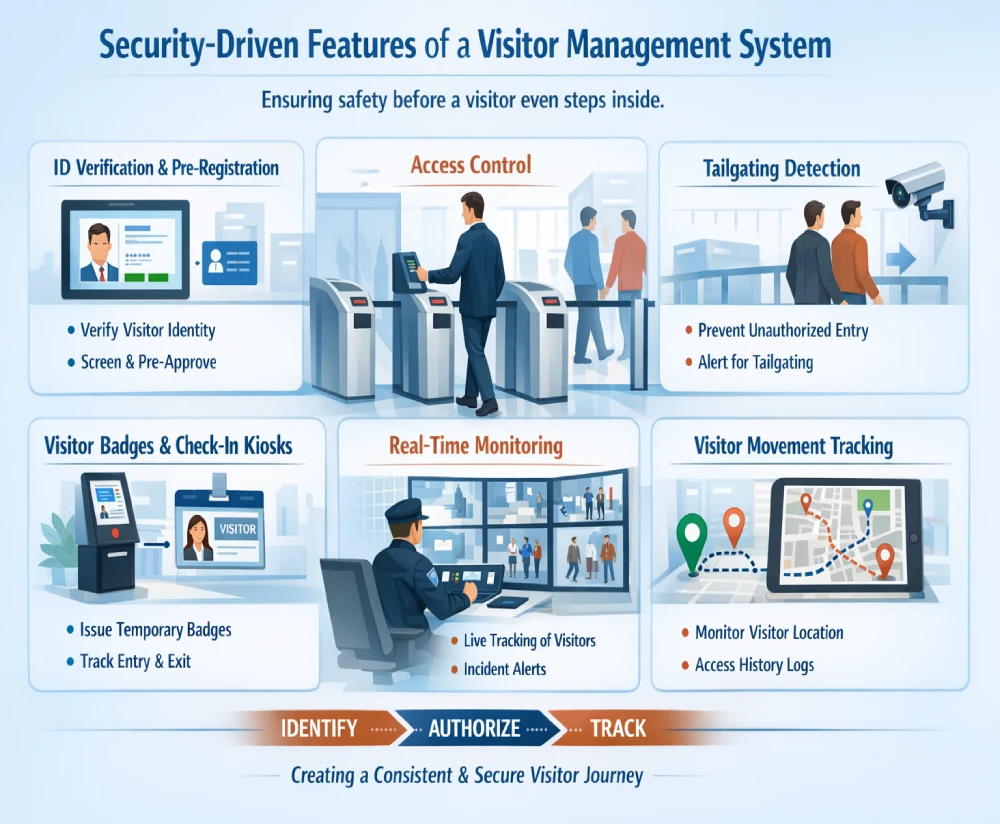
A workplace should be secure even before one of the visitors enters. The visitor management system features are designed to block unauthorised access and enforce access decisions consistently. Instead of relying manually on staff alone, a modern office visitor management system establishes security as a built-in outcome of the visitor journey.
In the means of safety, unwanted visitors will get exposed to tailgating, identity misrepresentation and gaps on a real-time basis. The features of the visitor management system directly address these risks by ensuring every visitor is identified, authorised, and visible at the workplace. The visitor check-in system, visitor access control system, and visitor tracking system work together to create a secure feedback cycle rather than stand-alone security.
Security-focused visitor management system features are about consistency. They are concerned with transparency, awareness of who is around, why they are there, which areas they can access and what they can’t access. Clarity converts security to an operational state rather than a task that can be conducted in reaction.
Visitor Identification and Identity Verification Features
Workplace security is based on identity. A visitor identification system establishes trust at the entry point by requiring every individual who enters the workplace to be identified and associated with a purpose of visit. Compared to manual sign-in processes, a modern visitor management system confirms identity before verified actions are taken.
The process of identity verification usually starts in the pre-registration stage, or on-site check-in verification, where visitor information is registered and checked. This can be the ID scanning issued by the government, the process of matching the visitor records with records of the expected visits, or verifying the identity with the host’s approval. The role of visitor access management software here is not just to collect data for its own sake, but also to create accountability.
Access Control and Visitor Entry Management Features
After establishing identity, the second security service is access control. A visitor entry system determines when a visitor enters the workplace and under what conditions. This is where the visitor access control system applies organisational policies for each zone, timeframes, and authorisation levels.
Effective access control visitor management contrasts the concept of permission from physical movement. Access is authorised by means of approvals, rules or pre-authorisation, and physical access is by means of controlled access points. The system enables organisations to set specific access policies without having manual intervention in each door.
For instance, a guest can be permitted to access a reception area and can be prohibited from accessing restricted areas or functional levels. The time-based rules will make sure that there is an automatic expiry of access, which will minimise the chances of unauthorised access. These controls convert the visitor access into a courtesy-based procedure into a regulated security process.
Real-Time Visitor Tracking and On-Site Visibility
Security goes beyond entry; that’s why it is important to ensure that individuals are aware of the current working premises in order to control their safety and operations. A visitor tracking system provides real-time transparency into visitor presence, location status, and visit hours during their stay in the workplace.
Through modern visitor management systems, visibility is typically delivered through a centralised visitor management platform that displays active visitors, hosts, and authorised areas. This awareness assists in evacuation operations and removes guesswork during security checks.
Real-time tracking has everything to do with accountability. The constant visibility completes the security loop that commenced with identity and access control and makes sure that visitors are controlled throughout their on-site lifecycle.
Compliance-Focused Features of a Visitor Management System
In modern workplaces, compliance is not a one-time requirement but a continuous working condition. A well-designed visitor management system is integrated into everyday workflows by ensuring that visitor data, permitted decisions, and records are handled consistently and accurately. Instead of relying on manual processes, software for visitor management establishes tracking, safety standards, and audit transparency by design.
The features of visitor management systems that support compliance do not function independently. They act as a permanent record of permitted access, what data was gathered, and the duration of retention of data. This networked framework enables organisations to illustrate conformity by action.
Digital Visitor Logs and Audit-Ready Records
The foundation of compliance is based on digital visitor logs. Compared to manual sign-up paper sheets, visitor management system features create structured, searchable records that document the visitor management system. Active history records or logs contain identity information, visit intent, association of host, entry and exit time, and permissions.
These logs are not passive storage. They are used as accountability instruments through which organisations can rebuild events properly during audit, investigations or compliance reviews. Searchability and history access make records readily accessible and eliminate operational risk and burden.
Once informal recordkeeping is replaced by standard digital records, organisations shift away towards reactive compliance to the ongoing audit preparedness.
Consent Capture, Document Signing, and Data Governance
Most visits entail more than mere identification. Access may be pre-requisite by legal acknowledgements, safety policies and confidentiality agreements. A modern visitor management platform integrates permission recording and document signing directly into the visitor workflow.
These visitor management solutions ensure that the requirements are completed before the permission is granted, not after an incident occurs. Digital consent records are automatically linked with the visitor profile, which builds a track of compliance. The software for visitor management, governance rules define how long documents are retained and who can access them, lessen the risk for legal exposure and ensure responsibility for managing data.
Visitor Data Security and Privacy Controls
There is responsibility in visitor data. A visitor access management system permits those within the organisation to view, edit, or export visitor information. Role-based permissions, retention and deletion rules make sure that data is managed in a manner that is proportional and transparent.
Within compliant visitor management systems, limiting unnecessary exposure of personal information reinforces trust for privacy purposes. Moreover, information is stored until it is needed operationally or legally necessary before it is removed safely based on policy. This governance-first approach positions visitor management as a responsible data steward rather than a passive data collector.
Control-Oriented Features That Govern Visitor Access
The distinction between simple visitor tools and a system that can be used in an enterprise comes in the form of control. Whereas the security is preventative and compliance records-driven, control specifies the decision-making, enforcement, and review.
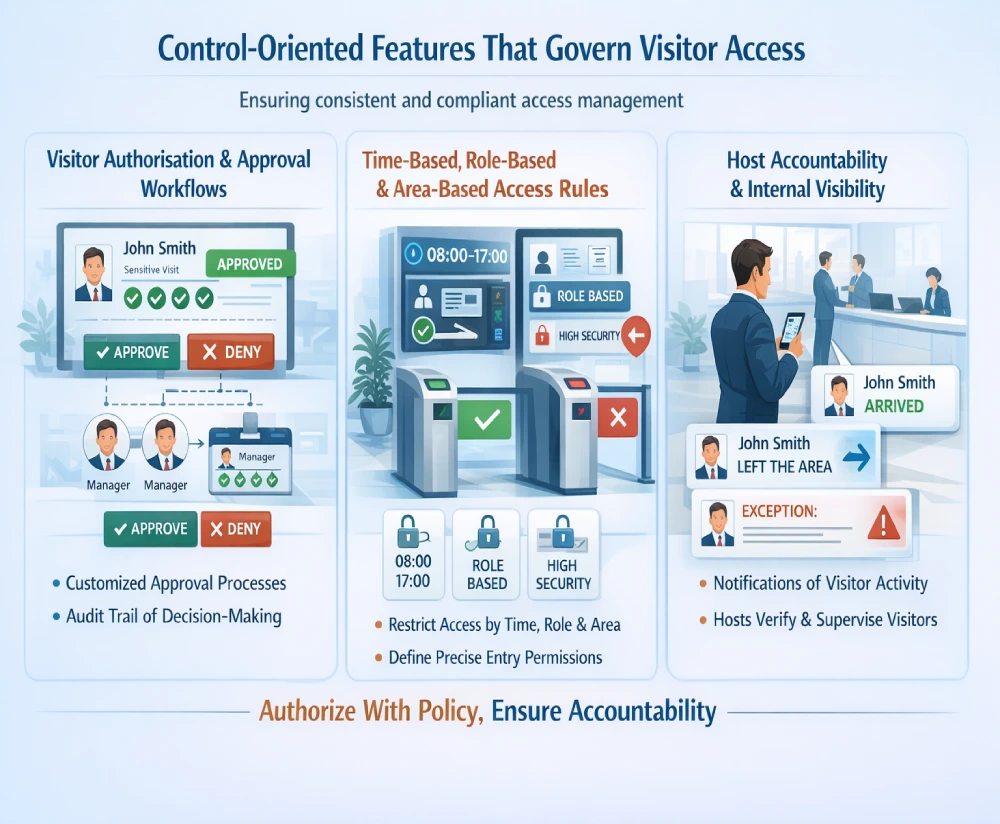
A visitor management strategy built on control enables organisations to operate with confidence and stability, even as the number of visitors and workplace challenges arises. A smart visitor management system applies authorisation logic to workflows that allows access decisions to align with internal policies.
Visitor Authorisation and Approval Workflows
Authorisation processes permit who is authorised to approve access, as well as the terms under which. Using visitor access management software, organisations approve an algorithm that reflects internal accountability structures. As an illustration, sensitive visits are supposed to be approved by the manager, whereas routine visits have their own rules.
This visitor management system tool ensures that responsibility is clearly assigned. All approvals or disapprovals are recorded, thus providing a traceable decision-making process that would strengthen governance and minimise confusion in the auditing or incident.
Time-Based, Role-Based, and Area-Based Access Rules
Control becomes practical through policy. A visitor access control system makes precise limitations based on time, role, and physical area. These rules are applied automatically at the visitor entry system to maintain consistency regardless of staffing or visitor volume.
Time-based access prevents meandering, role-based access compares permissions with visit purpose, and area controls minimise access to high-security areas. A combination of these rules promotes safety since the visitors are not allowed to exceed their intended purpose or stay longer than they should.
Host Accountability and Internal Visibility
Visitors never live in isolation; they are always accompanied by a host. A structured guest management system establishes host accountability by making internal stakeholders responsible for the visitors they invite.
Within modern visitor management workflows, hosts are notified of arrivals, departures, and exceptions of each visitor. This mutual visibility makes sure that visiting people are supervised and the accountability is not vested with either the security or reception teams. Responsibility is shared without causing tension in operations to strengthen organisational control.
Operational and Reception Management Features
Efficiency in operations should go hand in hand with governance in visitor handling. A modern office visitor management system improves daily reception workflows and strengthens security or control. Instead of relying on improvised processes, reception visitor management becomes a standardised, consistent function governed by system rules.
The visitor check-in system is the working bridge between the visitors and the hosts, and the policies of the workplace are to be followed by every visit, which makes the flow of the visit constant for the visitors.
Digital and Contactless Visitor Check-In
Digital check-in replaces manual check-in processes with digital and systematic operations. Through contactless visitor management, visitors will confirm their identity, complete required procedures, and receive access instructions without relying on staff manual intervention for every action.
The value of a modern visitor check-in system is based on consistency. The process is the same for every visitor, so the data can be collected correctly, the identity can be verified, and the access regulations can be imposed immediately. This minimises mistakes, unauthorised access, and ensures that operational efficiency is not at the cost of control.
Reception Automation and Front Desk Efficiency
Reception teams have a broad field of duties that are exclusive of welcoming visitors. Office visitor management software runs routine tasks such as notifications, badge assignments, and check-out reminders, allowing staff to focus on monitoring rather than data entry.
Effective reception visitor management does not remove human involvement, but rather supports it. Smart systems will make sure that the staff are following the workflow every time and eradicating reliance on memory or informal workflow.
This leads to a reception service that is conducive to security and compliance, and at the same time satisfies professional visitor experience. See how Othership’s visitor management software brings security, compliance, and reception efficiency into one platform.
Smart Automation and Workflow Features
Automation in visitor management is about reliability. A smart visitor management system uses standardised rules and conditions to manage visits proactively. An automated visitor management system maintains consistent implementation of policies without constant manual monitoring.

Automated Visitor Management Workflows
Workflows are automated to activate actions depending on whether the visitor is approved or rejected. For instance, access may be issued after the verification of identity has been successfully done, or automatically denied when a visit has expired. These processes make sure that policies have systematic enforcement.
An automated visitor management system lessens the chance for human error by eliminating unnecessary changes. All visitors are on the same controlled route, which promotes operational control and discipline.
Custom Visitor Types and Smart Rules
Not every guest poses the same level of risk and does not need the same access. A smart visitor management system allows organisations to define visitor categories accordingly, such as vendors, interviewees, or contractors and apply customised rules.
These regulations modify permissions to access, approvals and visibility depending on the type of visitor. This guarantees that governance grows with work complexity without any additional friction and manual decision-making.
Integration and Platform-Level Features
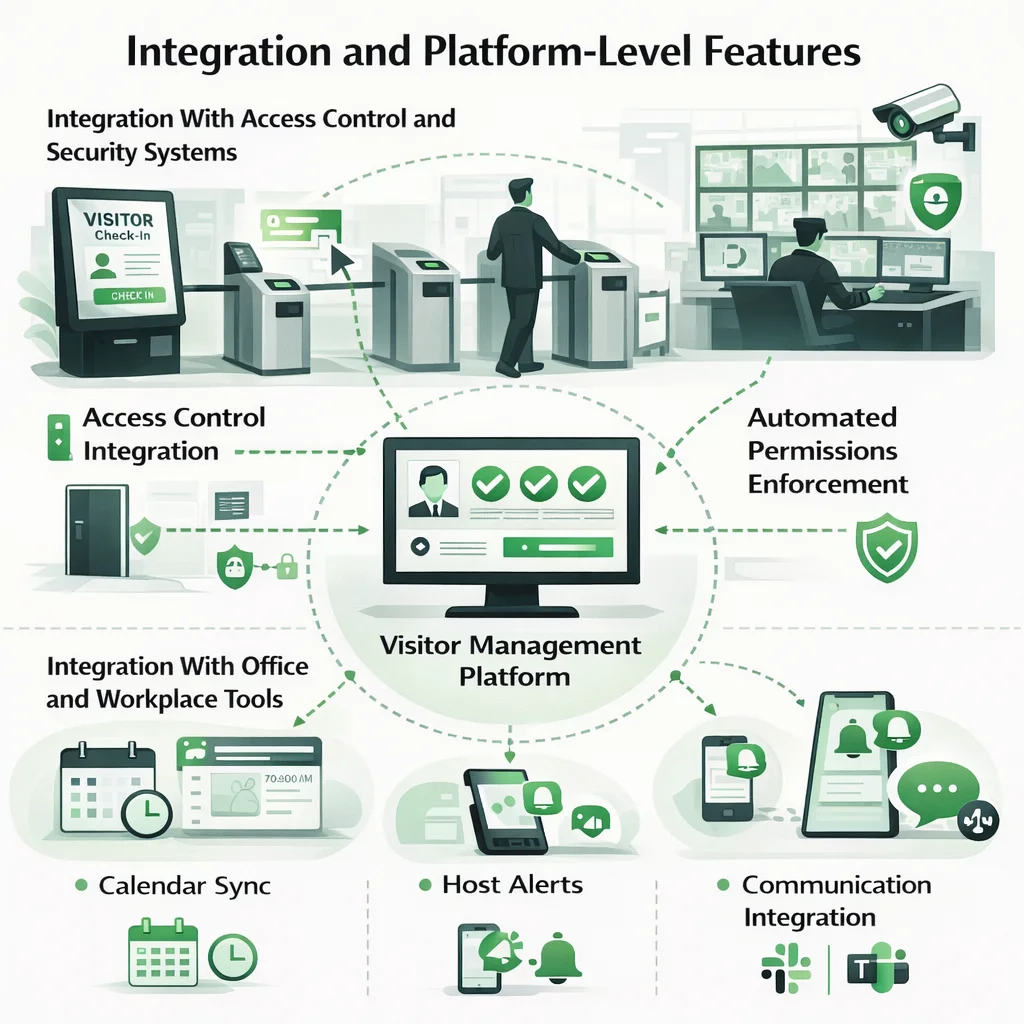
Visitor management operates systematically. A modern visitor management platform functions as part of a broader workplace ecosystem that connects security, facilities, and operational systems. Software for visitor management must integrate procedures seamlessly to provide consistent enforcement across tools.
Integration With Access Control and Security Systems
Direct connections to physical access systems make it possible to enforce digital permissions in reality. Through access control visitor management, visitors gain access only to authorised areas, while unauthorised attempts are blocked instantly. The integration eliminates the need to coordinate between systems manually, eliminates security gaps and ensures the access decisions are carried out correctly.
Integration With Office and Workplace Tools
A centralised visitor management platform works through scheduling, communication, and workplace tools to align visitor workflows with daily routines. This interrelated structure can be used in host notifications, visit scheduling or internal visibility.
Reporting, Analytics, and Decision-Support Features
Visitor data is transformed into operational intelligence through reporting. Modern visitor management system features transform raw activity logs into constructive insight that supports security planning, compliance monitoring and improving operations. These are used to guide decisions.
Reports expose patterns in visitor volume, access exceptions, visit duration, and host activity through enterprise-grade visitor management solutions. Security teams can see common risks, facilities teams can predict the capacity requirements, and compliance teams can ensure that the policies are always followed. It is all in clarity- to know not only what transpired, but how and why it transpired and how many times.
Therefore, the well-governed analytics reinforce confidence by permitting organisations to measure the effectiveness of their visitor management framework over time.
Discover how Othership.com will enable teams to track, analyze, and maximize office visitor traffic.
Choosing the Right Visitor Management System for Your Workplace
A visitor management system for office environments must function as a control framework. Selecting the right system requires evaluating how the features of the visitor management system are associated with organisational risk, scale, and needs.
Decision-makers are advised to judge upon the cooperation of identity verification, access control, tracking, and reporting. Manual implementation systems or modules that are not interconnected present loopholes in both enforcement and visibility.
The best solutions promote the workflow, which is policy-driven, audit-ready, and scalable governance without growth in operational activities. This systematic assessment is based on the results, including security consistency, confidence in compliance, and control of operations.
Final Thoughts
The contemporary workplace does not settle for simple visitor logging. The features of the visitor management system advance how organisations protect people, govern access, and maintain accountability through an integrated framework.
An office visitor management system delivers security through prevention, compliance through traceability, and control through governance. This means that visitor management is no longer just a reception, but it is a workplace system that supports trust, safety, and operational confidence for each and every visitor.
Are you ready to upgrade your visitor management strategy? Discover Othership’s visitor management software built for today’s workplaces.
Frequently Asked Questions
What are the most important features of a visitor management system for modern workplaces?
Identity verification, access control, real-time tracking, digital logs, consent capture, and reporting are considered to be the most important factors of the system. Together, these visitor management system features create security, compliance, and control.
How do visitor management system features improve workplace security and access control?
By establishing verified identity, enforcing access policy, and maintaining real-time visibility, to prevent unauthorised entry and improve incident response through a structured visitor access control system.
Which visitor management system features help organisations meet compliance and data privacy requirements?
Digital logs, consent workflows, retention policies, and access permissions within visitor management systems support data governance.
How does a visitor management system control visitor access across different areas of an office?
Through role-based, time-based, and area-based rules enforced by a visitor entry system and integrated access controls.
What features should an office visitor management system include for efficient reception and check-in?
A reliable visitor check-in system, reception automation, and host notifications ensure consistency while maintaining governance.
How do visitor tracking and visitor log features support safety and accountability?
A visitor tracking system provides live awareness, while digital logs document decisions and movements for accountability and review.
What is the difference between basic and advanced features of a visitor management system?
Basic systems record entry. The identity, access, approvals and data are managed by advanced systems in integrated workflows and automation.
How should businesses evaluate visitor management system features when choosing a solution?
They ought to determine the interaction of features to help them in supporting security, compliance, and control, as opposed to considering tools individually.


You must be logged in to post a comment.