

Visitors today no longer simply check in at the front desk and sign a paper log to access workplaces. Clients, vendors, contractors, interviewees, and short-term partners now enter offices, frequently working flexible hours and in varying locations. As these interactions increase, organizations are reassessing the value of visitor management and the risks linked to manual processes.
Many workplaces are still using traditional practices to secure visitor information. Traditional practices such as handwritten logs, spreadsheets, or informal check-in processes may appear sufficient at first, but they often fail to be consistent, precise, or accountable. These challenges help explain why visitor management is important in modern office environments.
The benefits of visitor management system adoption begin with recognizing its role as a fundamental workplace method. An organized system of visitor management facilitates safer conditions, better documentation, and more effective processes, which are hard to achieve with manual visitor management systems. This blog will help you explore why organizations are shifting from traditional visitor logs and how a visitor management system addresses evolving workplace needs in today’s standards.
Contents
- 1 Why Visitor Management Systems Are Critical Today
- 2 Key Benefits of Visitor Management Systems in Modern Workplaces
- 3 Signs Your Workplace Has Outgrown Manual Visitor Processes
- 4 Core Benefits of Using a Digital Visitor Management Platform
- 5 Essential Benefits of Digital Visitor Management Systems
- 6 Understanding Automated Visitor Management Systems
- 7 Common Workplace Environments That Rely on Visitor Management
- 8 Workplace Compliance and Visitor Record Management
- 9 Why Visitor Security Is a Core Workplace Requirement
- 10 How Organizations Evaluate Visitor Management Software
- 11 The Evolving Role of Visitor Management in Modern Workplaces
- 12 Final Thoughts
- 13 Frequently Asked Questions
- 13.1 1. What is a visitor management system, and how does it work?
- 13.2 2. Why is visitor management important for modern workplaces?
- 13.3 3. What are the main benefits of using a visitor management system?
- 13.4 4. How does a visitor management system improve workplace security?
- 13.5 5. Can a visitor management system help with compliance and audits?
- 13.6 6. Is visitor management software suitable for small offices?
- 13.7 7. What is the difference between a digital and an automated visitor management system?
- 13.8 8. When should an organization switch from manual visitor logs to a visitor management system?
Why Visitor Management Systems Are Critical Today
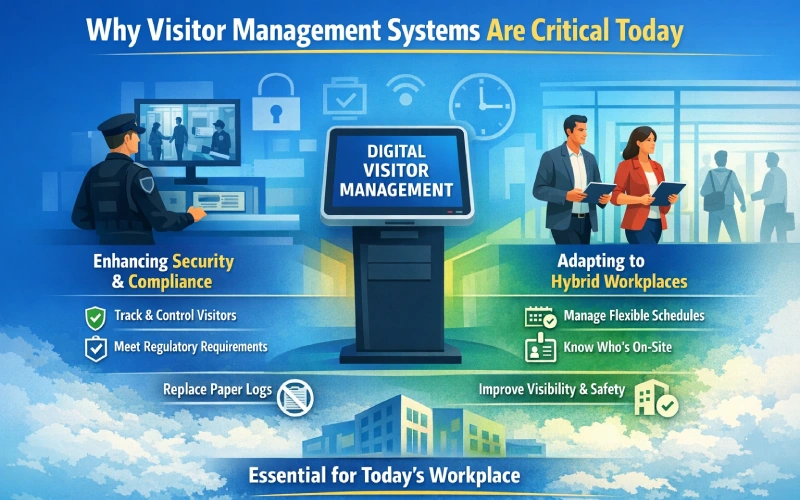
Because the conditions under which offices operate have transformed, visitor management systems have become an essential tool in many workplaces. This section explains why adoption is no longer optional for many organizations and highlights the broader purpose of visitor management system use in today’s workplaces.
Visitor management is there to offer visibility and control of the entry of people to a workplace, the purpose of their visit, and the duration of their stay. As organizations face increased accountability requirements and more dynamic work patterns, the importance of visitor management has expanded beyond basic recordkeeping.
Changing Workplace Security and Compliance Expectations
The expectations of security in the workplace have changed over time. Organizations are now supposed to show evident control of activity on-site and third-party access. Unauthorized visitors in both regulated industries and corporate settings may present organizations with lapses and vulnerabilities.
Paper visitor records are hard to audit and can be easily tampered with. Information can be changed, pages may be lost, and no one ever checks access times. Such constraints complicate the process of setting accountability in case of incidents.
In order to address these challenges, the structured visitor management system supports consistent documentation and traceable records, and reinforces why visitor management is important in secure facilities.
The Impact of Hybrid Work on Visitor Control and Visibility
The use of offices has changed with the hybrid work. Employees can be present on-site a few days a week, reception desks can be unstaffed during some hours, and several teams can use the same area. These circumstances complicate visitor administration and increase the dangers of utilizing informal procedures.
Not having a clear system makes it hard to understand who should be in the building at that time. These gaps compromise the safety and operational confidence in the workplace. As hybrid work becomes standard, organizations increasingly recognize why visitor management system adoption supports clarity and control in flexible workplaces.
Key Benefits of Visitor Management Systems in Modern Workplaces
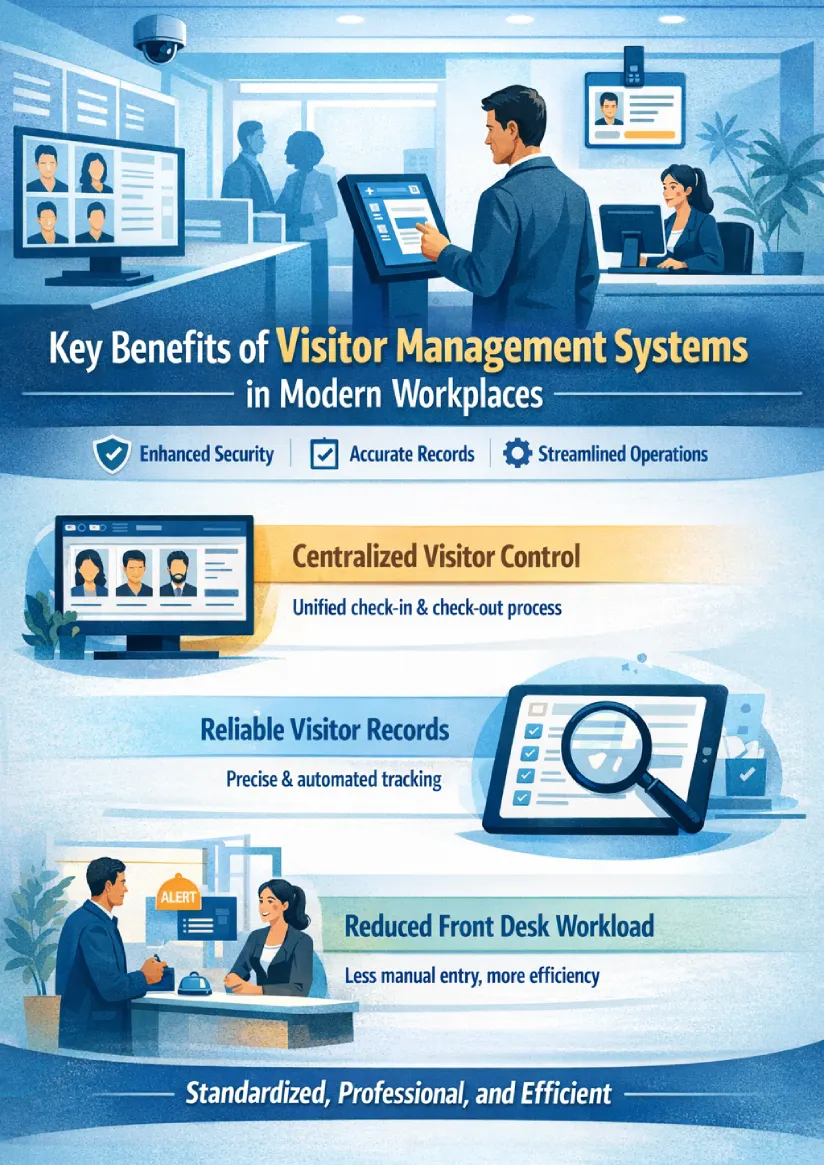
The key benefits of a visitor management system include improved security, reliable visitor records, and efficient operations. Centralizing processes leads to standardized procedures and increased professionalism for both guests and staff.
A visitor management system establishes order in place of manual processes that often depend on personal judgment or inconsistent practices. The advantages of a visitor management system become evident as workplace volumes diversify and operate across multiple locations.
Centralized Control Over Visitor Entry and Exit
Centralized control is a strategy for visitor management systems. Rather than relying on scattered logs or verbal approvals, organizations gain clarity through a unified view of visitor activity. This structured approach ensures visitors are properly checked in and out, preventing confusion about who is present.
Workplaces also enhance accountability by substituting fragmented procedures with one process and lessening the use of memory or manual follow-up. This control directly contributes to safer and predictable operations.
Improved Accuracy of Visitor Logs and Records
The records should be precise to ensure clarity of operation and preparedness for compliance. Manual logs are vulnerable to human errors, omissions, and inconsistencies. In contrast, a structured system enhances the quality of visitor information by standardizing data collection.
This improvement in data quality is a key benefit of visitor management system adoption. Investigations, audits, and internal reviews are supported with reliable records without the need to align incomplete logs, which is time-consuming.
Reduced Manual Work for Front Desk Teams
Visitor check-in tasks often burden front desk and administrative teams. Manually verifying details, notifying hosts, and maintaining records interrupts other responsibilities, resulting in inefficiency and a higher risk of mistakes.
Reducing repetitive administrative work is one of the practical aspects of a visitor management system. Visitor processing in a standard procedure helps the staff to concentrate on activities of greater value to an institution while visitor experiences remain professional and regulated.
Signs Your Workplace Has Outgrown Manual Visitor Processes
Recognizing when manual visitor tracking becomes inadequate is a pivotal step toward improving workplace operations. This section identifies common indicators of this transition, tying back to the earlier discussion about the rising importance of visitor management and the necessity for updated systems.
Paper-based processes tend to be time-consuming as office volumes increase or evolve. This conflict would be evident in situations where the number of visitors grows or the requirements for compliance rise.

Lack of Visibility Into Office Visitors
When visitor data is stored in several logs or formats, it is hard to obtain a real-time view of who is in the building. This invisibility causes confusion in emergencies and makes daily operations difficult.
Security Risks Created by Paper-Based Logs
Paper records offer little security against unauthorized access or data abuse. Any visitor information can be seen by anyone who walks near the front desk. This raises privacy concerns and security risks.
That is why visitor management is important from a risk prevention perspective. Due to the growing focus on secure and responsible working environments that organizations are putting in place, the shortcomings of manual logs may occur.
Inconsistent Visitor Experience
Inconsistent check-in procedures can erode professionalism and trust. Tourists may receive conflicting instructions depending on the front desk or office staff assisting them. Over time, such inconsistencies can harm the organization’s reputation.
A visitor management system for office environments supports consistent processes that enhance clarity and predictability for both visitors and employees.
Core Benefits of Using a Digital Visitor Management Platform
Digital visitor management solutions move workplace operations from reactive to proactive approaches, demonstrating the importance of digital systems and how they ensure consistent visitor management.
Visitor activity becomes challenging as organizations grow or use flexible work approaches. A visitor management solution maintains clarity by standardizing how visitors are registered, tracked, and recorded across locations. These results form the foundation of the visitor management system advantages.
Automated Visitor Check-In and Notifications
Automation makes visitor check-in easier. When visitors are registered using a digital system, their data goes immediately to the right stakeholders. Automation speeds up the process.
This is a well-organized strategy that enhances the speed and uncertainty reduction at entry points. Automated notifications ensure that the hosts are informed of arrivals promptly, supporting smoother coordination and reinforcing the visitor management system’s advantages.
Real-Time Visitor Tracking Across Locations
Transparency is a key benefit of digital visitor management. Real-time monitoring lets companies know who is present at any time, across locations and office sizes. This is especially valuable to shared workplaces and cannot be achieved with spreadsheets. That is why digital systems offer such value in operations.
Standardized Visitor Processes Organization-Wide
Regularity is necessary for professional and compliant visitor processing. Digital platforms allow organizations to establish standard processes that are applicable in the departments and across locations to minimize confusion and errors, and at the same time, the visitors also get the same degree of clarity, regardless of the location of check-in.
Upgrade to digital visitor management to automate check-ins, gain real-time visibility, and standardize visitor processes across every location with Othership today!
Essential Benefits of Digital Visitor Management Systems
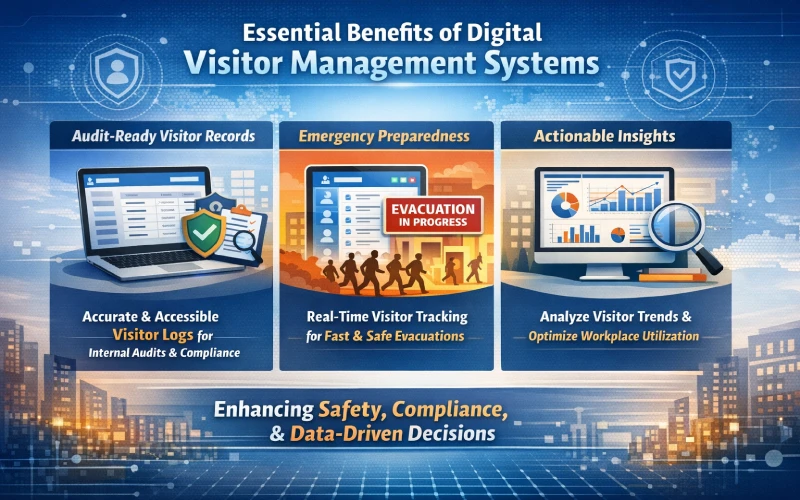
Beyond operational efficiencies, digital visitor management systems support broader organizational goals related to safety, compliance, and data-driven decision-making.
This section expands on visitor management system benefits by focusing on the outcomes that extend beyond daily check-ins and how it can be used to understand the long-term worth of implementing organized visitor procedures as a component of workplace infrastructure.
Audit-Ready Visitor Records
Audit preparedness requires the maintenance of the availability records of each visitor. Digital systems are information systems that store information in a standard format and make sure that the information is presented instantly when it is needed.
Audit-ready visitor records enable internal checks and external reviews without using fragmented records.
Emergency Preparedness With Real-Time Data
During emergencies, it is important to be aware of who is in the area. Digital visitor management systems provide real-time data to create faster responses and establish clearer communication during evacuations for safety.
This reinforces the visitor management system benefits related to team member and visitor safety. On the other hand, manual loggings such as paper-based records may be unreliable for storing information during these circumstances.
Actionable Insights From Visitor Data
In the long run, visitor data will show trends in terms of office utilization, peak office hours, and space utilization. Digital systems enable this information to be analyzed without undergoing extra administrative work.
Understanding Automated Visitor Management Systems
The term automation is commonly spoken of at a general level, and the definition of automation in visitor management is rather narrow and result-based. This segment explains the meaning of automation and the reason why it enhances the integrity of the visitor procedure.
What Makes a Visitor Management System Automated
An automated system uses predefined rules and workflows in visitor handling. This involves the ability to gather information uniformly, activate notifications, and update records without the need to perform the process manually at every stage.
These can minimize the reliance on human activity and provide a stable visitor management, even in the most active periods of the year and with changes in staffing. Automation supports the broader goals of visitor management software by reinforcing reliability.
How Automation Reduces Errors and Delays
Automation is the best replacement for manual processing, such as missing entries, incorrect timestamps, and delays, through the implementation of a systematic process that is automated. Minimizing errors helps increase reliability on visitor records and reduces interruptions.
Common Workplace Environments That Rely on Visitor Management
Visitor management is applicable to multiple workplace industries. This section emphasized the relevance of organized visitor management in various settings and how the systems become responsive to diverse needs. This will help you understand how the role of the office visitor management system is a versatile operational tool.
Corporate Offices and Enterprise Workplaces
Big offices tend to accommodate a great number of visitors and entrances. Visitor movement can hardly be tracked, and it is likely to be inaccurate without having a clear, systematic framework. A visitor management system for office environments has centralized monitoring and a consistent routine to reduce reliance on manual coordination and strengthen security by collecting visitor data.
Co-working and shared workplaces accommodate diverse visitors every day, whether they be temporary guests or permanent visitors. Therefore, it is necessary to establish clear visitor policies and effective tracking. A visitor management solution not only provides transparency and fairness in access management, but it also ensures that all users follow the same protocols.
Regulated and High-Security Facilities
There should be precise and traceable visitor records in high-security facilities. That’s why digital visitor management systems help support accountability and documentation by reinforcing the importance of visitor management in sensitive environments.
Workplace Compliance and Visitor Record Management
Visitor management maintains the accuracy, accessibility, and consistency of visit records. This section will explain how compliance considerations reinforce the importance of visitor management and clarify the broader purpose of visitor management system adoption.
As the expectations on data management and accountability of organizations continue to grow, many informal visitor tracking technologies may no longer meet the standards. Hence, an organized system would facilitate the responsible collection and storage of visitor data in order to maintain operational transparency.
Why Visitor Security Is a Core Workplace Requirement
Security of visitors is no longer a peripheral issue that is handled at reception desks; it is a core workplace requirement. This section explains why visitor management system adoption supports workplace safety and why visitor control is essential to modern operations.
A safe workplace demands proper monitoring of any visitor access. Organizations are at a greater risk when there is no consistency in visitor handling or undocumented visitor handling.
Visitor management systems support controlled access, structured identity confirmation, and accountability, which contribute to a safer environment without interruptions. Understanding the importance of visitor management helps position visitor management as a foundational security practice.

Access Control Through Structured Visitor Processes
The distinct identification of visitors and authorization initiates regulated access. A well-organized visitor management process will allow the visitor to be registered, authorized, and observed based on the pre-set workplace policies.
Risk Prevention and Workplace Accountability
One of the main products of efficient visitor management is accountability. Through the means of continuous monitoring and recording the movements of visitors, the organizations will be able to react more efficiently to occurrences or inquiries.
Supporting Employee Safety Through Visibility
Clear procedures will assist in minimizing uncertainty and instilling confidence in safety measures at the workplace, and assure employees that visitors are controlled and observable. Maintaining up-to-date visitor information will help organizations support team member confidence and strengthen the perceived value of a visitor management system as part of daily operations.
See How Othership Enhances Workplace Visitor Security.
How Organizations Evaluate Visitor Management Software
Choosing a suitable system is done through careful consideration of the needs and the environment in which the organization operates. This section explains how workplaces approach evaluating visitor management software without focusing on product comparisons or pricing.
Organizations can begin by assessing their current visitor processes and identifying gaps regarding visibility, consistency, or compliance. These assessments will help clarify what a visitor management solution must support to be effective.
The evaluation criteria typically include usability, scalability, and appropriateness in terms of its use within the existing workflow in the workplace. Instead of seeking feature volume, organizations prioritize reliability and adaptability as key characteristics of effective visitor management system features.
The Evolving Role of Visitor Management in Modern Workplaces
Visitor management is an evolving concept as workplaces become more digital. This section talks about the evolution of visitor management to extend beyond basic access monitoring.
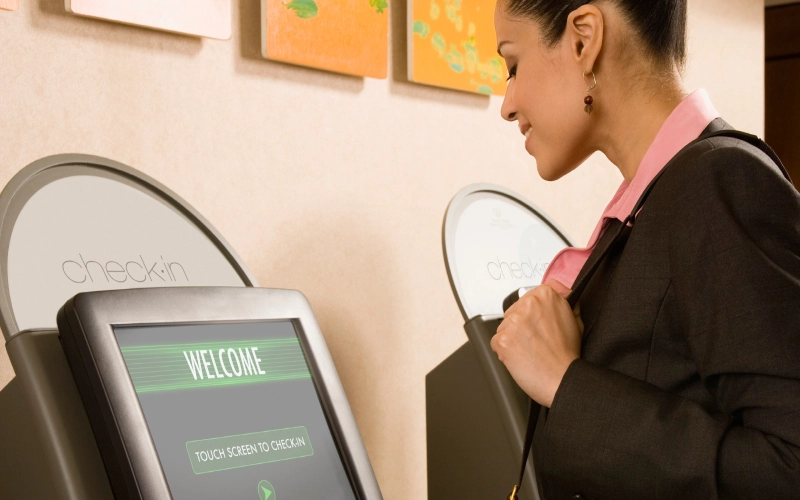
A visitor management system now supports broader organizational goals related to transparency, safety, and operational efficiency. As the workplaces grow more connected, visitors’ data assists in creating a picture of how the physical spaces are used and managed.
The shift toward digital infrastructure highlights the importance of visitor management as a long-term investment rather than a reactive measure. Visitor management systems increasingly function as part of the workplace technology ecosystem.
Final Thoughts
As offices become more dynamic, the advantages of visitor management system adoption are increasingly tied to outcomes such as improved visitor security, clearer accountability, stronger compliance readiness, and more advanced daily operations.
Since manual visitor processes can hardly meet the demands of the modern workplace, formal systems, on the other hand, introduced standardization, openness, and reliability within locations and divisions by addressing the underlying challenges of visitor handling.
Organizations reinforce the importance of visitor management as part of a broader operational and safety strategy. It supports better decision-making, safer environments, and more professional visitor experiences on modern workplace systems. Get Started with Othership Visitor Management Software.
Frequently Asked Questions
1. What is a visitor management system, and how does it work?
A visitor management system replaces manual log use with standardized visitor check-in and records the entry and exit time, and has good records of visitors. The system comes in handy in making organizations transparent and answerable without necessarily resorting to informal means.
2. Why is visitor management important for modern workplaces?
The modern workplace is highly educated and has a wide range of visitors who work different hours and have common working conditions. The lack of a program to manage visitors in an organization puts them at greater risk of getting exposed, being less visible, and having unequal visitor experiences.
3. What are the main benefits of using a visitor management system?
The primary benefits of using a visitor management system include improved security oversight, reduced administrative workload, more reliable visitor records, and stronger compliance readiness. These effects help organizations to be more efficient, accountable, and professional.
4. How does a visitor management system improve workplace security?
A visitor management system improves security by ensuring visitors are properly identified, authorized, and recorded. Limited access and real-time visibility help to prevent unauthorized access and respond faster in case of an incident.
5. Can a visitor management system help with compliance and audits?
Yes, the availability of digital visitor records makes compliance possible because of the capacity to achieve consistent, retrievable records of visitor activity. This helps in holding organizations responsible in the case of audits or internally conducted reviews.
6. Is visitor management software suitable for small offices?
A visitor management software solution can be effective for both small offices and large enterprises. The smaller work environment is easier and homogeneous than larger organizations, which are scalable and centrally controlled. Office size does not matter; richness is in the processes.
7. What is the difference between a digital and an automated visitor management system?
A digital system simply replaces paper logs with electronic records, but an automated system takes a step further by reducing the level of human intervention through pre-defined workflows. Automation minimizes errors and time-waste, hence enhancing reliability.
8. When should an organization switch from manual visitor logs to a visitor management system?
The manual logs are to be considered as the cases to transfer to the organizations when visibility gaps, security threats, or discrepancies in the visitor experience occur due to manual logs.


You must be logged in to post a comment.