

The contemporary work environment requires different systems for security, access control, and compliance. Security systems protect the workplace from threats, access control systems determine who can enter certain areas, and compliance systems ensure that organizations follow rules and regulations. When visitor processes are separate, risks and operational inefficiencies increase.
Integrated visitor management systems solve disjointed processes by merging security and other workplace functions for secure, modern operations. Businesses can no longer afford isolated solutions. Siloed processes limit visibility and amplify risk, while integration transforms visitor management into a critical layer of organizational security.
Contents
- 1 What Is an Integrated Visitor Management System?
- 2 Why Workplace Security, Access Control, and Compliance Cannot Operate in Silos
- 3 How an Integrated Visitor Management System Unifies Workplace Security
- 4 How Visitor Management Integration Strengthens Access Control
- 5 The Role of Visitor Management Software in an Integrated Workplace System
- 6 Visitor Management Software as the System of Record
- 7 Compliance as a System Outcome of Integrated Visitor Management
- 8 From Visitor Entry to Exit: The Integrated Visitor Lifecycle
- 9 Integrated Visitor Management for Enterprise and Multi-Location Workplaces
- 10 Key Benefits of an Integrated Visitor Management System
- 11 Conclusion: Why Integrated Visitor Management Is a Core Workplace System
- 12 FAQs: Integrated Visitor Management System
- 12.1 1. How does an integrated visitor management system improve coordination between security teams and workplace operations?
- 12.2 2. What happens when visitor access control is not integrated with visitor management workflows?
- 12.3 3. How does visitor monitoring change when control and visitor management are connected?
- 12.4 4. Can an integrated visitor management system reduce compliance risks without adding manual processes?
- 12.5 5. How does visitor identity act as a control layer in access control and security systems?
- 12.6 6. Why is centralized visitor data important for audit readiness and accountability?
- 12.7 7. How do integrated visitor management systems support scaling across multiple offices or locations?
- 12.8 8. What role does visitor management software play in maintaining consistency across security and access policies?
What Is an Integrated Visitor Management System?
An integrated visitor management system is a coordinated set of digital tools that connects visitor information. This includes names and reasons for visiting, identity verification, and physical security controls like electronic door locks or badge readers. This system works as a unified part of workplace operations.

Real integration means that different systems communicate and work together so their actions are coordinated. This goes beyond simply connecting software. Integrated systems share data automatically, using it to make security decisions—such as allowing or denying access—without manual intervention.
An integrated visitor management system provides authoritative control, since it is the central nervous system for external guest oversight. This foundational understanding is key for business leaders.
Definition of an Integrated Visitor Management System
An integrated visitor management solution coordinates multiple security layers. It synchronizes visitor data with access control and monitoring tools, which then provides one ultimate source of truth for the visitor.
How Integration Differs From Standalone Visitor Software
Using standalone software leads to information silos and visibility gaps. An integrated system systematically addresses these gaps, ensuring all systems use the same real-time data.
Why Workplace Security, Access Control, and Compliance Cannot Operate in Silos
When systems fail to communicate, organizations lose track of threats where they are most vulnerable. Access controls can’t deliver true security without real-time connections to visitor management data. At the same time, compliance grows more manual and error-prone if integration is absent.
These operational silos directly increase organizational risk. A failure in one system is not communicated to others. The workplace remains vulnerable despite having multiple tools.
Disconnected processes make a unified view impossible. Without shared reality, security, access, and compliance teams operate in fragments. This deep fragmentation is the exact challenge integration was built to resolve.

Security Risks of Disconnected Visitor Systems
Critical visibility gaps and manual errors result from disconnected systems. For example, a visitor’s approved entry might fail to sync with building access control. These mismatches have direct, negative effects on security outcomes.
Compliance Gaps Created by Isolated Visitor Processes
Fragmentation in visitor records accelerates when isolated processes run unchecked. Auditors, when facing this scenario, will struggle to reconstruct complete visitor timelines. As a result, proving compliance becomes harder and risk inevitably rises.
Lack of Visitor Visibility Without Centralized Monitoring
Centralized visitor monitoring, which means tracking all visitors from a single control point, is a critical feature. Real-time awareness—knowing where visitors are at any moment—greatly improves security. Central monitoring shifts security from reacting to problems to actively managing situations as they arise.
How an Integrated Visitor Management System Unifies Workplace Security
With an integrated visitor management system, security becomes a built-in outcome. Daily operations link visitor safety directly to core business processes. Automated coordination replaces most manual intervention, streamlining workflows even further.
The system enforces policies consistently across all touchpoints. Visitor monitoring and access decisions are inherently linked, which creates a secure environment that is both intelligent and adaptive.
Unified security reduces reliance on human memory and procedure. The technology orchestrates a predefined security protocol automatically. And this results in stronger, more reliable protection for everyone.
Visitor Identity Verification and Authorization
Visitor identity acts as a foundational security control layer. The system uses this identity to drive authorization logic automatically. Using this method prevents access without depending on the security personnel.
Real-Time Visitor Monitoring Across the Workplace
Coordinated visitor monitoring brings vital operational insight. Its focus is on visible movements and locations, never on invading privacy. Through real-time clarity, security staff stay informed about every guest’s location and movements.
Automation drastically reduces unauthorized access and human error. The system ties common errors to previously disconnected manual workflows. It then eliminates those steps through integrated, logical processes.
How Visitor Management Integration Strengthens Access Control
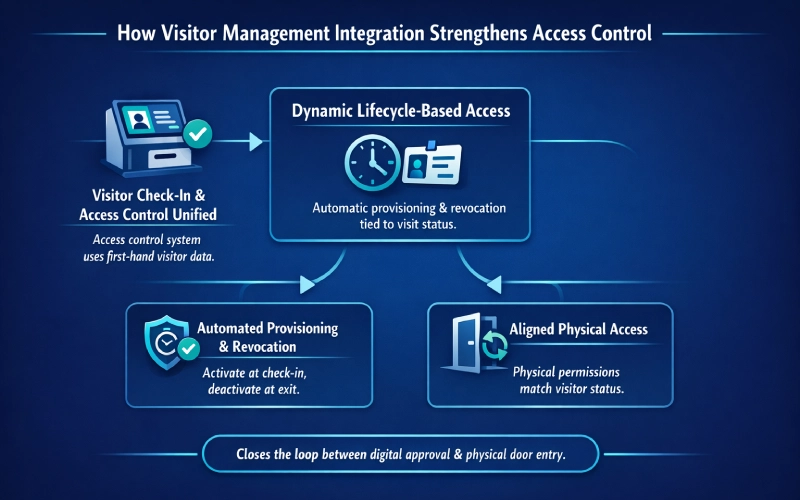
Integration makes access control and visitor management a single function. The access control system takes first-hand information from the visitor check-in process. Permissions are dependent and unconditionally related to the role of the visitor.
This connection creates a dynamic, lifecycle-based approach to access. Provisioning and revocation become automatic, timed events, as the system matches physical access privileges with live visitor status.
An access control visitor management blend is powerful. The solution provides a guarantee that a visitor’s physical rights are in line with his or her present approval. This closes the loop between digital approval and physical door entry.
Connecting Visitor Check-In With Access Permissions
The system automates access provisioning and revocation. Access is granted only for specific times and areas, ensuring permissions are temporary and purpose-driven.
Automating Access Provisioning and Revocation
The system automates provisioning and revocation; access activates at check-in and ends at exit, reducing security risks.
Aligning Physical Access With Visitor Status
Physical access permissions constantly track visitor status, triggering actions based on that status for continuous synchronization.
The Role of Visitor Management Software in an Integrated Workplace System
Visitor Management Software is the most important system integration facilitator. It takes the position of the main record system for visitor information. This platform orchestrates security, access, and compliance workflows.
This visitor management solution coordinates actions across other tools. It does not aim to dominate all features but to join them. The software enables a scalable integration across workplace technologies.
Solutions like Othership demonstrate this modern, integrative approach. They provide the platform that unifies disparate workplace systems smoothly. The visitor management system access control link becomes seamless.
Take action now—modernize your workplace entry and elevate security with an integrated visitor management system. Learn more at www.othership.com.
Visitor Management Software as the System of Record
The software becomes the single source of truth for visitor information. Every single integrated tool can utilize the same central, authoritative data set. This, in turn, removes any discrepancies between records and guarantees uniformity throughout the system.
Orchestrating Security, Access, and Compliance From One Platform
Security, access, and compliance are integrated into one platform. This is a clear demonstration of how the cooperation of systems can yield benefits in all three areas at once. The platform delivers the process, not through each isolated tool.
Enabling Scalable Integration Across Workplace Tools
A robust visitor management system promotes flexibility and growth. It makes possible the integration of various tools that are employed by organizations with numerous sites. This kind of flexibility is very important for organizations that are big and have complicated structures and are in the process of expanding.
Compliance as a System Outcome of Integrated Visitor Management
An integrated system reframes compliance as an automatic outcome. The visitor management system access control generates perfect logs, thus the creation of digital records is part of the normal functioning of the system.
Every visitor event is fully traceable due to this automation. Consent management and data accountability are built into the workflow. The system enforces privacy regulations by its design, which eliminates human intervention to a great extent.
The reporting of the visitor access management system allows instant audit readiness. Auditors can access detailed, centralized reports with just a few clicks. Compliance then shifts from a costly scramble to a constant state.
Automated Visitor Logs and Digital Records
The system produces automated visitor logs and digital records that are tamper-evident. The entire process of entry, movement in the building, and exit is recorded with a precise timestamp. Hence, an immaculate audit trail is produced without any additional work.
Consent Management and Data Accountability
Privacy and consent management become high-level, system-managed functions. The system records and saves the permissions of the guests during the registration process. Thus, the data responsibility remains throughout the duration of the visitors.
Audit Readiness Through Centralized Reporting
Centralized reporting keeps the organization always ready for an audit. Full visitor histories are accessible in an organized and comprehensible manner. With this readiness, a stressful affair becomes merely a customary affair.
From Visitor Entry to Exit: The Integrated Visitor Lifecycle
An integrated system provides end-to-end control of the visitor lifecycle. Visitor access control begins even before the guest arrives. This chronological flow ensures no gaps in security or oversight.
The system makes intelligent decisions at each stage automatically. From pre-registration to record retention, everything is connected. This delivers a seamless yet secure experience for visitors and staff.
This holistic control is a strong signal of mature security practice. It demonstrates that visitor management is a core, considered framework. That said, the entire process is designed, not assembled from parts.
Pre-Registration and Identity Validation
The lifecycle starts with pre-registration and remote identity validation. Hosts approve visitors before they ever reach the premises. The security measures put in place are potent and are declared by the federals.
On-Site Monitoring and Access Control
On-site visitor monitoring and access control work in unison. The technology monitors where visitors are and compares that with the places they are allowed to go. Unforeseen events can be dealt with right away if their locations are known in real time.
Visitor Exit, Access Revocation, and Record Retention
Access is automatically cancelled when a visitor leaves, and at the same time, the record of the visit is finalized. The system holds the entire record of the visit for retention by automatically archiving it. This not only secures the closing of the loop but also gets ready for upcoming audits.
Integrated Visitor Management for Enterprise and Multi-Location Workplaces
Visitor management systems that guarantee consistency are a must for large firms. Uniform security policies are applied all over the areas by the integrated system. This results in central monitoring and at the same time, permits necessary local control.
A centralized dashboard offers a single pane of glass for oversight. The centralized dashboard provides a single view for monitoring, so site managers keep control over the daily approvals of visitors at their locations. This equilibrium is essential for good governance in large-scale scenarios.

These systems naturally favor hybrid and flexible workplace models. They make sure that visitors are secure regardless of the location, whether the main office, a branch office, or a shared space. Therefore, security and experience cannot be different across the corporation.
Standardizing Visitor Security Across Locations
The system is the same everywhere when it comes to visitor security. The method of verifying a person’s identity and giving authorization is the same at all sites. Thus, an easily identified security network with a similar approach everywhere in the corporation is created.
Central Oversight With Local Control
Management is provided with a central view into visitor numbers and trends. The local crew decides daily who can host and interact with people on-site. Operationally flexible governance systems also demonstrate a sound issue of security.
Supporting Hybrid and Flexible Workplaces
Integrated systems secure visitors in any company-associated space. Their versatility indeed allows them to occupy different types of commercial spaces, ranging from lofty office towers to shared working areas. This very quality keeps the organization’s security investment for the future still intact.
Key Benefits of an Integrated Visitor Management System
Stronger security for visitors and access control, plus integration, are the main advantages of the system. A visitor management system that is integrated makes security a process in the system and, therefore, an automatic one. It lowers the risk through coordination, not only by increasing the features.
Significantly improved compliance and risk management are a consequence of the system’s main automatic feature. The system minimizes manual processes where errors and omissions occur. It transforms compliance from being a cost center into a very rich advantage that is baked in.
Better operational efficiency and a more pleasant visitor experience are indirect consequences. Staff time is freed from administrative tasks for higher-value work. Visitors enjoy a professional, smooth, and modern arrival process.
Stronger Visitor Security and Access Governance
Security strengthens through unified access control and visitor management. Governance policies are enforced consistently by the system itself. This creates a robust, reliable security environment for all. Overall, it creates a strong and reliable security environment for everyone.
Improved Compliance and Risk Management
Automation of logging and reporting by the system leads to improved compliance. Risk management is enhanced due to full visibility and automated controls. The organization gains protection and peace of mind simultaneously.
Better Visitor Experience and Operational Efficiency
The visitors undergo a quick, expert, and contactless check-in procedure. The operations teams get to spend much less time on manual coordination and data input. This advantage is directly linked to the strength of system integration.
Conclusion: Why Integrated Visitor Management Is a Core Workplace System
An integrated visitor management system is now a core workplace system. It is essential for modern security, compliance, and operational excellence that’s why business leaders must view it as critical infrastructure.
The integration elevates simple visitor management to a strategic framework. It establishes a well-defined method for visitor security and responsibility. The right Visitor Management Software gives this transformation a chance.
A single approach distinguishes modern, advanced management. There are solutions like Othership to support this inevitable transformation. The path to a unified and safe workplace starts with this choice. The transition to a unified and secure office begins with this decision.
Turning Visitor Management Into a Security and Compliance Framework
Visitor management programs in security systems now extend beyond mere visitor management and towards total security and regulatory compliance. It provides the structure for consistent policy enforcement and auditing. Such transformation is mandatory for the contemporary organization that is conscious of the risks.
Reflect on the potential of a contemporary platform in achieving your security objectives in an integrated manner. Exploring a solution like Othership is a logical step for growth-minded leaders. This really applies to intelligent, unified management of workplace environments. Can we begin?
FAQs: Integrated Visitor Management System
1. How does an integrated visitor management system improve coordination between security teams and workplace operations?
A consolidated, collaborative source of truth is formed for every visitor’s information. Security and operations departments have a watch on the same real-time data and situation. This not only leads to the occurrence of no discrepancies in reporting but also allows the teams to react proactively and in a coordinated manner.
2. What happens when visitor access control is not integrated with visitor management workflows?
A dangerous gap opens between digital approval and physical entry. A visitor who checked in at the front desk may not have authorized door permissions. This forces manual intervention and creates significant security and compliance blind spots.
3. How does visitor monitoring change when control and visitor management are connected?
The shift in monitoring goes from simply logging to being actively and intelligently overseen. The system matches a visitor’s actual location at the moment with the zones they are allowed to access. Security gets contextual awareness and can therefore, very quickly, raise alarms or report on policy breaches.
4. Can an integrated visitor management system reduce compliance risks without adding manual processes?
Yes, it automates the creation of accurate, tamper-evident audit trails. Compliance logs are generated as a byproduct of normal system operation. Those are the automatic taking over from the manual method of data entry, which is mostly responsible for the errors and doubts.
5. How does visitor identity act as a control layer in access control and security systems?
It serves as the foundational key that unlocks conditional permissions. The verified identity dictates what areas the visitor can access and for how long. The events related to security that happened later are directly linked to an authorized person.
6. Why is centralized visitor data important for audit readiness and accountability?
It ensures the entire custody of the visitor is complete and unbroken. The auditors have the chance to view the whole process from pre-registration to exit via one source. In contrast, gathering data from various sources results in incomplete records and noncompliance.
7. How do integrated visitor management systems support scaling across multiple offices or locations?
The centralized platform’s security policies are uniformly applied throughout all locations. While data is being sent to the corporate dashboard, the same rules are enforced in every location. This not only secures data across the enterprise but also simplifies reporting throughout the organization.
8. What role does visitor management software play in maintaining consistency across security and access policies?
It is the policy engine that consistently applies the same rules to all visitor interactions across the board. The software guarantees that the same verification and authorization logic is applied to all entrances. This, in turn, reduces randomness and eliminates human discretion, which might end up compromising security.


You must be logged in to post a comment.