

Ineffective meetings still cost US companies around $399 billion in 2019, showing how much impact poor meeting habits can have. Meetings have long been steered by shared expectations unspoken norms, respectful communication, and ordered participation.
These standards governed traditional workplaces, ensuring focused, collaborative discussions. Gradually, these conventions defined business meeting etiquette, creating consistency in how teams align, decide, and resolve issues.
What remains unchanged are the essentials: effective meetings rely on organization, preparation, and mutual respect. Teams count on clarity, accountability, and disciplined technology use, both in hybrid spaces and physical rooms. Modern meeting etiquette is not just about courtesy but about ensuring clear communication and preventing conflict in complex systems.
Contents
- 1 What Is Meeting Etiquette?
- 2 What Is Microsoft Teams Meeting Etiquette?
- 3 Types of Meetings & Why Etiquette Differs for Each Format
- 4 Core Meeting Etiquette Rules That Improve Productivity
- 5 Virtual Meeting Etiquette: Rules for Video Calls, Remote Teams & Online Collaboration
- 6 Hybrid Meeting Etiquette: Creating Fairness Between Remote & Onsite Participants
- 7 Meeting Room Etiquette: How to Use Shared Rooms Respectfully & Efficiently
- 8 Meeting Room Booking Etiquette: Avoiding Conflicts, No-Shows & Double-Bookings
- 9 Bad Meeting Etiquette Examples (And How to Fix Them)
- 10 How Technology Supports Better Meeting Etiquette (Automation, AI & Smart Scheduling)
- 11 10. Do’s and Don’ts of Proper Meeting Etiquette (Quick Reference List)
- 12 Final Thoughts: Why Good Meeting Etiquette Creates Better Workplaces
- 13 FAQs: Meeting Etiquette & Productivity
What Is Meeting Etiquette?
Meeting etiquette refers to the professional behaviors and guidelines that help meetings run smoothly, respectfully, and productively for everyone involved. For teams to improve meeting culture, there needs to be a shared understanding of what good etiquette looks like. This includes knowing how meetings are structured, why etiquette matters, and how traditional practices adapt to today’s digital and hybrid work environments.
At its core, meeting etiquette shapes collaboration by guiding how people communicate, listen, and engage with others, whether in person or online. In modern workplaces, especially across virtual and hybrid settings, strong etiquette helps keep discussions focused, inclusive, and efficient.
What Is Microsoft Teams Meeting Etiquette?
Microsoft Teams meeting etiquette includes the best practices and professional behaviors that help virtual meetings run smoothly, respectfully, and efficiently. It involves being punctual, muting when not speaking, communicating clearly, and staying engaged to support productive collaboration in a digital environment.
Meeting Etiquette Meaning
Meeting etiquette comprises the responses, expectations, and shared practices that enable effective teamwork. It dictates how people prepare, contribute, and collaborate without causing inconvenience. These expectations serve as guidelines that ensure order, fairness, and reduce misunderstandings across settings.
Realistically, etiquette would involve punctuality, preparation, active listening, staying present, and using tools in a responsible manner. In traditional offices, this was called proper meeting etiquette, but in today’s offices, it requires a more purposeful understanding of these standards.
Why Meeting Etiquette Matters in Modern Workplaces
The current organization relies on effective communication and alignment. The essence of meeting etiquette is valued more than ever, given the distributed teams and digital collaboration tools. Being precise prevents people from wasting time and having unproductive discussions.
Proper etiquette makes meetings run smoothly. Messages are clearer, goals stay visible, and decisions come faster. This builds psychological safety and equal participation, both vital in hybrid and virtual settings.
How Meeting Etiquette Supports Productivity & Collaboration
Etiquette strengthens team cohesion by keeping everyone focused on goals. It prevents side conversations, multitasking, and distractions that diminish productivity. By adopting common practices, teams reduce friction, accelerate decisions, and lessen the need for follow-up meetings.
Etiquette builds respect in both physical and online settings. Traditional expectations, like preparedness and attention, now apply to habits such as muting microphones and managing backgrounds, supporting more effective participation.
In summary, meeting etiquette is a shared code of conduct that ensures meetings are meaningful and effective. Key takeaways: establish clear definitions of etiquette, respect traditional and digital norms, and promote efficiency and respect in all meeting formats.
Types of Meetings & Why Etiquette Differs for Each Format
Different meeting formats require different etiquette to ensure effective communication and collaboration.
There is no single rulebook that applies to every meeting. Modern workplaces rely on a mix of formats, including in-person, virtual, and hybrid meetings, each with its own communication challenges and expectations.
Understanding these differences helps set clear expectations for how participants should engage across physical and digital environments. Effective collaboration depends on adapting behavior to the meeting format, as etiquette standards can vary between business meetings, team discussions, online sessions, and video calls.
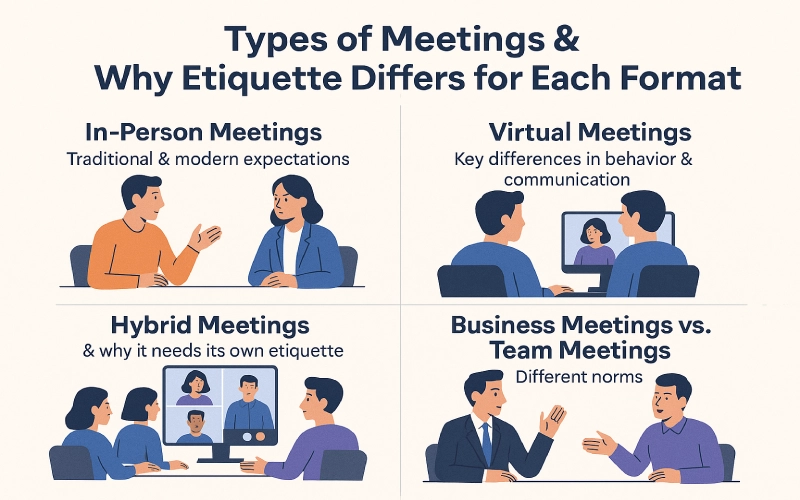
In-Person Meetings (Traditional & Modern Expectations)
Etiquette in this case focuses on presence, time, eye contact, and respect for the common spaces. The subjects have to handle physical cues, not to interrupt, and live up to room-use expectations. Even though these are traditional expectations, they are also relevant in the modern-day office, where professionalism is also a necessity.
Virtual Meetings: Key Differences in Behavior & Communication
Virtual meetings have a different set of habits rooted in clarity, digital etiquette, and proactive interaction. Due to the limitations of body language and visual cues, the tone, order of speaking, and use of tools become more important.
Participants must control microphones, manage backgrounds, and ensure reliable connectivity to limit disruptions. They also need to actively engage to close the gap during virtual interactions and sustain collaboration.
Hybrid Meeting & Why It Needs Its Own Etiquette
A hybrid meeting is a combination of remote and onsite participants, which creates the problem of fairness. So what is a hybrid meeting? It is a gathering in which a few of the members are present physically, and others integrate via video system.
This format demands special standards of behavior since the communication barriers, audio mismatches, and the discrepancy in participation naturally arise. Both teams should have rules that define fairness and orderliness in the interaction between the two groups.
Business Meetings vs. Team Meetings (Different Norms)
Knowing these differences will help participants choose the right behaviors at the right times. This results in fewer misunderstandings and improved outcomes.
- Business meetings: Business meetings typically demand more formality, structured agendas, set speaking order, and documentation.
- Team meetings: Team meetings enable open collaboration, brainstorming, and flexible conversation flow.
Core Meeting Etiquette Rules That Improve Productivity
Strong meeting etiquette tips and professional meeting etiquette practices help turn meetings into focused, efficient, and goal-driven sessions.
Intentional behaviors make meetings more productive and purposeful rather than time-consuming. Regardless of format, consistent etiquette improves clarity, alignment, and accountability across teams.
These meeting etiquette tips provide professionals with a strong foundation to improve meeting culture in hybrid, virtual, and in-person settings. They encourage better collaboration, shared responsibility, and more effective use of time.
Applying professional meeting etiquette leads to clearer communication, faster decision-making, and more focused discussions while preventing common issues like multitasking, off-topic conversations, unclear agendas, and poor documentation.
Clarify the Meeting Purpose & Agenda Early
The core rules for meetings are to clearly define the purpose of the meeting. Participants must be aware of the purpose of the session, the decisions to be arrived at, and the kind of preparation to be made. Having a clear agenda will help in keeping the focus on track, eliminating idle discussion, and predetermining the results.
Start & End Meetings On Time
Punctuality is the proof of proper meeting etiquette. Late arrival ruins time and indicates a lack of respect for the time of other people. The day should end on time in order to keep the momentum on and the teams to handle the workloads. The long-term trust and dependability in the culture of the team are also reinforced by time discipline.
Communicate Clearly & Let Others Contribute
Meetings would be effective when there is a smooth flow of communication. Active listening, clear speaking, and space allowance for contribution contribute towards balance. Professionalism requires professionals not to be domineering in discussions but rather to promote other points of view, particularly in cross-functional discussions.
Avoid Multitasking & Stay Fully Present
One of the largest productivity killers is multitasking. Looking at emails, chatting with people, or going through irrelevant documents decreases the quality of involvement and slows down the decision-making. Being present can make the conversations effective and reduce miscommunication.
Keep the Meeting Focused & Avoid Side Conversations
Meetings tend to get off track due to sidebar conversations, digressions on the subject, or unnecessary arguments. It is not only respectful to be focused, but it is also an essential part of effective working as a team. When necessary, facilitators are supposed to redirect the discussions on the agenda.
Summarize Decisions & Assign Action Items
A good meeting concludes with an effective conclusion. Return to decisions, delegate, and make notes. This helps to reinforce accountability, avoid misunderstanding, and continuity of progress once the meeting is over.
Othership’s room booking software helps support punctuality, reduce double bookings, and streamline scheduling — creating a more accountable meeting culture.
Virtual Meeting Etiquette: Rules for Video Calls, Remote Teams & Online Collaboration
A Virtual meeting etiquette defines the expected behaviors that keep online meetings clear, respectful, and productive.
Virtual collaboration often comes with challenges such as audio issues, camera disruptions, background noise, low engagement, and misunderstandings due to limited visual cues. Without strong virtual etiquette, meetings can quickly become disorganized and ineffective for participants.
That’s why clear remote meeting etiquette is essential. In physical settings, body language, tone, and presence help guide interactions. In virtual environments, these cues are reduced, making structured communication, attentiveness, and proper online conduct even more important for smooth collaboration.
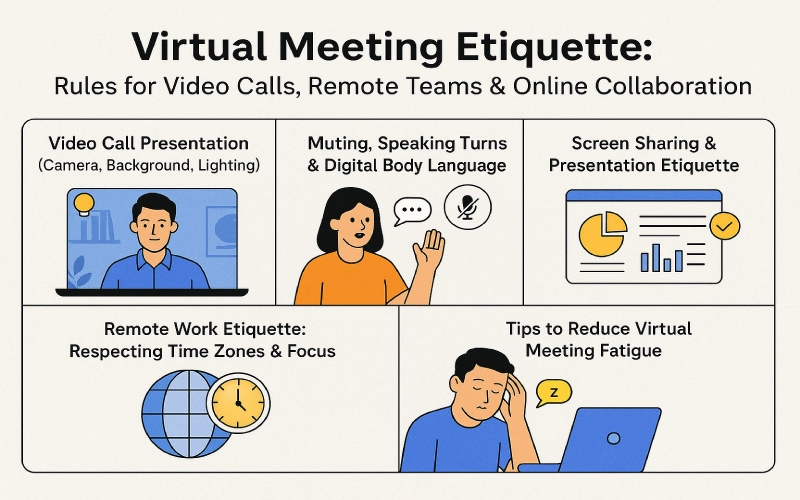
Video Call Presentation (Camera, Background, Lighting)
Even on the web, professional presence is important. Good video call etiquette is using proper lighting, positioning the camera at eye level, and making sure that the backgrounds are clean. Eye contact should also be observed as the participants look towards the camera when talking.
Muting, Speaking Turns & Digital Body Language
Expressive speaking prevents the number of interruptions, particularly during bigger meetings. Digital cues may be used by the participants, such as raising hands, reactions, or typing in the chat, to facilitate the communication process.
Screen Sharing & Presentation Etiquette
In cases of shared screens, the presenter must close unneeded tabs, turn off notifications, prepare the materials, and pre-read the material. Transparency is essential in this stage of video meeting etiquette. This makes sure that attendees can follow along without distraction or confusion. AI text to video tools can transform key agenda points into short, visually engaging clips, helping participants grasp information quickly and stay focused during virtual presentations.
Remote Work Etiquette: Respecting Time Zones & Focus
Remote teams tend to cut across various territories. Time zones and managing workloads attentively are factors of effective remote meeting etiquette. They should also not schedule at impractical hours and should keep the disturbances to a minimum level by being completely alert.
Tips to Reduce Virtual Meeting Fatigue
Online fatigue exists, and it may influence work. To alleviate the pressure, groups need to limit the duration of meetings, include breaks between calls, make asynchronous communication where available, and not use too many video sessions. These measures favor healthy and more sustainable distant collaboration.
Smart scheduling tools can assist by simplifying processes, lessening meeting overload, and making better virtual meeting best practices for organizations, enhancing remote workflows.
Hybrid Meeting Etiquette: Creating Fairness Between Remote & Onsite Participants
Hybrid meetings create different attendee experiences; some participants are physically present, while others join virtually. Proper hybrid meeting etiquette guarantees that every participant, either remote or in-person, has an equal opportunity for experience.
By following these meeting guidelines and rules for meeting etiquette, teams can foster inclusive communication, reduce frustration, and maintain productivity across distributed environments.
Equal Participation for Remote & In-Person Attendees
To be fair, the organizers of meetings and conferences ought to make a significant effort to incorporate both in-room and remote participants. Ask distant members to discuss some of the items on the agenda first and take turns so as to avoid domination by face-to-face members. Using chat features or reaction tools helps ensure all voices are heard, reinforcing strong remote meeting etiquette.
Room Setup, Audio & Camera Positioning for Hybrid Fairness
Balanced participation is dependent on proper room set-up. The cameras must be able to record the whole room, whereas the speakers can be clearly picked up by the microphones. In-room materials and participants should be visible to remote attendants. These hybrid meeting tips prevent exclusion and enhance smooth interactions.
Managing Side Chats, Reactions & Distractions
Hybrid meetings are inclined to side conversations or multitasking that can exclude remote attendees. Create some ground rules on how to mute, chat, and respond to keep it interesting. Focused interaction supports hybrid meeting etiquette and equity.
Tips for Keeping Hybrid Meetings Efficient & Inclusive
Inclusion and Efficiency are two concepts that go together. Make meetings short, provide agendas in advance, and make brief decisions. These methods strengthen the rules for meeting etiquette and ensure hybrid meetings remain productive and diverse for all participants.
Meeting room etiquette sets the standard for using shared spaces in a respectful and efficient way.
Good meeting etiquette helps create a professional, organized, and fair workspace. Whether in private offices or coworking environments, it ensures smooth collaboration, reduces friction, and respects shared resources.
Clear guidelines, including staff meeting etiquette and Teams call etiquette, support productivity and minimize conflicts—especially in busy workplaces where rooms are shared across teams. Following these practices helps maintain cleaner spaces, better coordination, and more effective interactions.

How to Use Room Equipment Respectfully
Be careful of all the technicalities and equipment in the meeting room. Projectors, screens, video conferencing hardware, and other devices are to be utilized in accordance with the purpose, and the problems are to be reported quickly. These factors of meeting etiquette in coworking spaces ensure future teams depend on functional resources.
Entering, Exiting & Noise Control Etiquette
One should either come into a meeting room or leave it silently in order not to distract the discussion. Mobile phones need to be silenced, and the side conversations should be minimized by the participants. Respecting noise boundaries is crucial to proper business meeting etiquette and maintains a productive environment for everyone.
Clean-Up Rules Before Leaving the Room
Cleaning the room is not an option. Chairs are to be stacked, whiteboards are to be wiped, and any personal or group materials are to be cleared. This demonstrates respect for shared spaces and reinforces team meeting etiquette, promoting a harmonious relationship among coworkers.
Meeting Etiquette in Coworking Spaces
In the workplace, following meeting etiquette is mandatory. Book rooms accordingly, observe common regulations, and do not occupy common spaces in a monopolizing manner. Fairness is guaranteed by good behavior, and the image of all teams is professional.
Meeting Room Booking Etiquette: Avoiding Conflicts, No-Shows & Double-Bookings
Proper meeting room booking etiquette maintains an organized, productive workplace. Having no clear room scheduling etiquette, conflicts, double bookings, and unused reservations can occur in meeting protocols and disrupt workflows.
By following booking rules and adhering to the importance of meeting etiquette, organizations ensure fair access to shared spaces and reinforce professional accountability.
Always Use a Room Booking System — Not Verbal Reservations
Verbal reservations give rise to confusion and overlapping of schedules. Always use a computerized system to reserve rooms. This is a key part of meeting room etiquette, which always assures transparency and reduces scheduling conflicts.
Cancel or Release Rooms on Time
In case of cancellation or early termination of a meeting, it is always good to vacate the room immediately so that the entire team does not suffer. Following this habit supports meeting protocols and demonstrates respect for shared resources.
Avoid Room Hoarding or Overbooking
By booking beyond the required space, hoarding rooms or rooms are reserved, and this denies others the right to space. Respect room scheduling etiquette and reserve only what is necessary to maintain fairness.
How Smart Room Booking Tools (Like Othership) Improve Etiquette
The booking system streamlines the meeting room booking process, eliminates conflicts, and maintains a record of usage. Tools like Othership reinforce meeting room booking etiquette, promote accountability, and help teams maintain professional standards without additional administrative burden.
Bad Meeting Etiquette Examples (And How to Fix Them)
Recognizing bad meeting etiquette is as important as following the rules. Precautionary measures in identifying vulnerabilities enable teams to enhance cooperation and embrace the right practices. Following meeting etiquette tips prevents inefficiency and promotes better team meeting etiquette across all meeting types.
Talking Over Others or Interrupting
The incivility of participants destroys teamwork. Encourage turn-taking, and use digital signals like raising hands in virtual or hybrid meetings. This supports the meeting do’s and don’ts of professional conduct.
Attending Unprepared or Distracted
Participating in unplanned meetings is a waste of time and value. Participants should review agendas and relevant materials beforehand to maintain proper meeting etiquette.
Running Meetings Longer Than Needed
Unnecessary extension of meetings is annoying to participants and reduces participation. Stick to planned times and end meetings promptly to uphold Business Etiquette Tips.
Not Respecting Virtual or Hybrid Etiquette Norms
Failing to follow virtual or hybrid meeting etiquette—such as muting microphones, camera usage, or side conversations—creates imbalances. It is better to have clear rules and reminders to make the interactions smoother and fair to all involved.
How Technology Supports Better Meeting Etiquette (Automation, AI & Smart Scheduling)
Technology strengthens meeting etiquette by reducing friction, improving accountability, and streamlining workflows. Modern workplaces increasingly rely on smart meeting rooms, meeting room booking systems, and productivity tools to enhance both in-person and remote meeting etiquette.
By integrating systems that automate scheduling, track time, and support virtual collaboration, organizations can ensure consistent adherence to meeting protocols and improve video meeting etiquette.
Automated Scheduling Reduces Meeting Conflicts
Scheduling systems are automated to avoid the problem of booking the same session twice. Teams can coordinate efficiently, supporting strong meeting etiquette and keeping meetings productive without manual intervention.
Room Displays & Check-Ins Support Accountability
Online room boards and check-in services guarantee that the participants follow the schedules and do not invade the reserved areas. These tools reinforce meeting protocols and encourage a professional culture of punctuality.
AI-Assisted Notes & Time Alerts Improve Structure
AIs are capable of creating agendas, taking minutes, and sending time alerts. This ensures meetings follow a clear structure, enhancing remote meeting etiquette and overall efficiency without manual intervention.
Smart Rooms Reduce Disruptions & Boost Focus
Intelligent rooms, which have in-built audio-visual systems, automatic lighting, and occupancy sensors, reduce interruptions. These improve video meeting etiquette and create a more professional, distraction-free environment.
10. Do’s and Don’ts of Proper Meeting Etiquette (Quick Reference List)
Meeting Etiquette Do’s
- Prepare and go through the agenda.
- Respect speaking acts as a motivator.
- Open and close meetings punctually.
- Assign action items clearly.
- Use tools like meeting room booking software to avoid conflicts.
Meeting Etiquette Don’ts
- Do not interfere or speak over people.
- Do not multitask when in meetings.
- Always do not exceed due time.
- Don’t ignore virtual or hybrid meeting norms.
- It is not necessary to book meeting rooms and not to release bookings.
Final Thoughts: Why Good Meeting Etiquette Creates Better Workplaces
The importance of meeting etiquette shapes culture, productivity, and collaboration by applying good meeting etiquette to sustain clarity, respect, and also makes communication efficient. Clear meeting norms, business meeting etiquette, and meeting guidelines make predictions in workflows that enhance engagement and team outcomes in hybrid meetings.
Through Othership’s meeting room booking software, organizations can reinforce structure, visibility, and smart scheduling, making every meeting smoother, more organized, and more productive by combining cultural practices with modern tools.
If your organization wants to reinforce strong meeting etiquette, Othership’s meeting room booking software provides structure, visibility, and smart scheduling — making every meeting smoother, more organized, and more productive.
FAQs: Meeting Etiquette & Productivity
1. Why does meeting etiquette directly impact workplace productivity?
Meeting etiquette shapes how time, attention, and participation are managed during discussions. When rules around punctuality, turn-taking, preparation, and focus are clear, meetings stay structured and outcome-driven instead of drifting into unnecessary conversation. This clarity reduces wasted time and helps teams reach decisions faster.
2: What is proper meeting etiquette?
Proper meeting etiquette includes being punctual, prepared, respectful, and engaged, while allowing others to speak and keeping discussions focused.
3: What are the golden rules of meetings?
The golden rules are to start and end on time, stay on topic, listen actively, participate respectfully, and follow up on actions.
4. How does poor meeting etiquette affect team collaboration?
Poor etiquette often leads to interruptions, unclear communication, disengagement, and frustration among participants. Over time, this weakens trust and discourages active contribution. Teams collaborate more effectively when meetings feel respectful, inclusive, and purpose-led rather than chaotic or one-sided.
5. Can better meeting etiquette reduce meeting fatigue?
Yes. Etiquette rules that limit meeting length, encourage clear agendas, and reduce unnecessary attendance help prevent mental overload. Respecting focus time and avoiding excessive back-to-back meetings allows employees to stay energized and attentive during discussions that truly matter.


You must be logged in to post a comment.