

Clear visitor management strategies benefit organizations by strengthening security posture, reducing compliance exposure, and streamlining daily operations. Leaders increasingly view visitor management as a governance responsibility, not just an administrative task. These strategies help structure environments where data and assets intersect each day.
As organizations grow, informal visitor handling introduces risks and inconsistencies across locations. Implementing a leading visitor management system ensures accountability, transparency, and consistent decision-making. Business and HR leaders rely on these structured approaches to protect people and uphold workplace standards.
Today, alignment between policy, operations, and employee experience is essential in modern workplaces. A well-defined visitor management strategy maintains compliance while supporting productivity and hospitality. By combining security with efficiency, strategic visitor governance enables organizations to set clear expectations and create smooth, human-centered operations.
Contents
- 1 What Are Visitor Management Strategies?
- 2 Why Visitor Management Strategies Are Essential for Modern Workplaces
- 3 Traditional vs Modern Visitor Management Strategies
- 4 Core Components of Effective Visitor Management Strategies
- 5 Types of Visitor Management Strategies Used by Organizations
- 6 Aligning Visitor Management Strategies With Workplace Policies
- 7 Visitor Management Strategies for Hybrid and Flexible Work Environments
- 8 Turning Visitor Management Strategies Into Daily Operations
- 9 Measuring the Effectiveness of Visitor Management Strategies
- 10 Visitor Management Strategy vs Visitor Management System
- 11 Common Visitor Management Strategy Mistakes to Avoid
- 12 How Visitor Management Software Supports Long-Term Strategies
- 13 FAQs on Visitor Management Strategies
- 13.1 1. What does a strong visitor strategy actually govern beyond just signing people in?
- 13.2 2. Why should organizations treat visitor management as a strategic priority and not just a front-desk task?
- 13.3 3. How can visitor oversight improve security and compliance at scale?
- 13.4 4. What role do policies play in shaping visitor management workflows?
- 13.5 5. How do visitor strategies adapt to different visitor types and workplace models?
- 13.6 6. What metrics or signals help organizations measure the effectiveness of their visitor oversight?
- 13.7 7. Does technology replace strategy, or how do they work together?
What Are Visitor Management Strategies?
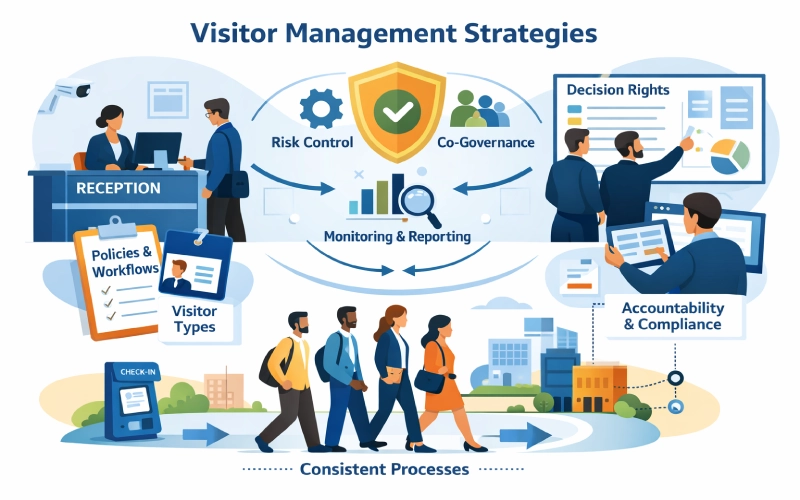
Visitor management strategies define how organizations govern every visitor interaction. They elevate visitor management from a receptionist’s task to structured operational governance. Moreover, they establish accountability across locations, teams, and visitor types.
A formal visitor management strategy covers policies, workflows, and decision rights. It ensures consistency in visitor management, regardless of staff or workplace changes, helping management eliminate uncertainty and manage operational risk.
Company leaders focus on visitors’ needs when creating management strategies, rather than on tools or technology. They emphasize co-governance, risk control, and repeatable outcomes across the organization, as it provides predictability.
Defining Visitor Management Beyond Check-In Processes
Visitor management goes beyond check-in sheets or badges. Check-in is just one step in the visitor journey, while effective management focuses on control, monitoring, and accountability.
The Role of Strategy in Modern Visitor Operations
Visitor management processes align people, policies, and workflows, as management methods create uniformity for different visitor types. A strategic approach transforms visitor handling into a controlled operational function.
Why Visitor Management Strategies Are Essential for Modern Workplaces
Unstructured visitor handling creates gaps in security, accountability, and trust. But with modern visitor management, these are addressed with clear regulations and controlled workflows. Professionals now use strategies to minimize risk and support workplace standards.
Regulatory requirements now expect organizations not only to track visitors but also to grant them proper access. A reliable visitor management process supports audits, reporting, and policy enforcement. Without a strategy, compliance relies on individuals rather than systems.
Security, Compliance, and Risk Exposure Without a Strategy
Visitor monitoring fails without clear security instructions for visitors. Untracked visitors create compliance gaps and audit risks, but with a proper strategy, accountability throughout every visitor interaction is ensured.
Operational Inefficiencies Caused by Manual Visitor Handling
The manual visitor check-in process is a time-consuming task that slows down reception and interrupts the workflow of employees. Besides, an irregular way of managing visitors leads to more mistakes and takes longer to resolve the issue. Over time, any operational inefficiencies pile up as the visitor numbers continue to grow.
How Workplace Scale and Hybrid Work Increase Visitor Complexity
Visitors in the workplace policy must adapt to fluctuating occupancy. Hybrid work reduces the predictability of hosts and space availability. And with strategies, a framework for navigating the variability of the workplace is secured.
Traditional vs Modern Visitor Management Strategies
Traditional visitor handling relies on manual judgment and fragmented record-keeping. These methods limit visibility, weaken visitor management accountability, and struggle to support the evolving demands of the workplace.
Modern strategies that underscore visitor management are governance, conformity, and corporate oversight. They standardize the visitor management process across teams and locations.
The difference between old and modern approaches lies in intent and control. Modern visitor management strategies focus on predictability, not convenience alone. They also align visitor oversight with broader organizational risk management.
Limitations of Manual and Reception-Driven Approaches
Manual visitor check-in depends heavily on individual judgment. A non-dynamic visitor management process does not work properly at high volumes. Visitor management models that rely on reception do not have the necessary control across the entire organization.
How Digital and Automated Strategies Changed Visitor Control
Automated visitor management systems standardize workflows and increase visibility and consistency. So with digital strategies, there’s a reduced reliance on human memory.
Strategic Gaps That Legacy Visitor Approaches Fail to Address
Legacy systems fail to provide consistent governance across multiple locations and cannot keep up with evolving visitor management requirements. Modern workplaces, by contrast, need adaptable frameworks that can grow and respond to changing demands.
Core Components of Effective Visitor Management Strategies
Effective visitor management strategies begin with clear identity verification and controlled access authorization. Organizations use structured visitor management rules to define who enters, where, and why. This clarity minimizes risk and misunderstanding within the organization.
The rules that are set up in the company reflect the company’s intentions and make them clear to all visitors. The visitor management process that has been defined makes it possible to apply the same rules no matter where or who the staff is.
The capturing of trustworthy data provides the possibility of seeing, auditing, and improving the process continuously. That’s why strong visitor management strategies rely on accurate records and oversight, as data-driven operational insights can help businesses make plausibly rational decisions.
Visitor Identity, Access Control, and Authorization
Visitor monitoring begins with verified visitor company information. An authorization process secures the passage of visitors through selected and approved areas only. So with Identity controls, internal security risks are reduced.
Policy Enforcement and Compliance Alignment
A visitor policy defines acceptable visitor behavior, while a workplace visitor policy ensures regulatory alignment. That said, strategies translate policies into enforceable actions.
Workflow Design for Different Visitor Types
A visitor management process varies by visitor category, and each visitor management procedure reflects specific risk levels. With workflows, different cases are treated in the same way.
Data Capture, Visibility, and Audit Readiness
The visitor management system’s characteristics guarantee accuracy in data. Data gathered is made accessible for audits and compliance checks, and this openness guarantees constant oversight. The structure and consistency provided by effective strategies empower companies to optimize visitor management.
Use leading visitor management software to strengthen governance. Discover how Othership lets you implement strategy seamlessly and elevate your workplace.
Types of Visitor Management Strategies Used by Organizations

Organizations select visitor management strategies based on their risk tolerance and operational priorities. Each approach reflects how managers balance security, compliance, and team member experience. The choice depends on organizational needs rather than trends. Security-oriented.
Visitor management highlights controlled access and very strict authorization protocols. Ground compliance-driven strategies grant precedence to documenting, auditing, and enforcing policies. These models are best suited for highly regulated or high-risk areas.
Experience-led visitor management reduces conflicts while keeping compliance. Mixed strategies make the visitor management process adaptable to mobile work models. These methods allow for productivity to thrive without control being given up.
Security-First Visitor Management Strategies
Visitor security procedures are mainly focused on the control of access. These strategies focus on risk mitigation and suit regulated or sensitive environments.
Compliance-Driven Visitor Management Strategies
A visitor management policy guides compliance-focused organizations. These strategies focus on documenting and auditing processes, as well as synchronize the visitor handling with the legal requirements.
Experience-Focused Visitor Management Strategies
The main goal of visitor experience management is to be efficient and professional. Such strategies make visits easier and faster. They balance control with hospitality.
Hybrid and Flexible Workplace Visitor Strategies
Visitors in the workplace policy adapts to hybrid schedules. Resilient strategies perform well in the face of unpredictable attendance and support a more dynamic use of space.
Aligning Visitor Management Strategies With Workplace Policies
Workplace governance starts with clearly defined visitor expectations and boundaries. A formal visitor policy lays the foundation for consistent oversight, because without alignment, visitor management strategies can lose authority.
Effective strategies turn policy into practical workflows, ensuring staff apply rules consistently across all situations. For organizations with multiple locations, uniform policy enforcement is essential. A standardized visitor policy supports consistency across teams and sites, reducing risks from varied local interpretations.
Why Visitor Policies Are the Foundation of Strategy
A visitor management policy is a way of establishing authority. Policies are the instruments that guide decision-making in different departments. Aside from that, they also avoid the problem of uneven treatment of visitors.
Translating Policy Rules Into Visitor Workflows
Visitor management guidelines guide operational flow, with each procedure reflecting the intent of policy. Proper execution ensures clear compliance without ambiguity.
Maintaining Consistency Across Teams and Locations
A workplace visitor policy standardizes expectations, reducing operational risk and ensuring consistent, uniform practices.
Visitor Management Strategies for Hybrid and Flexible Work Environments
Hybrid work brings in variable timings, collective areas, and random visitor patterns. Good visitor management methods give some order to the daily uncertainty, plus allow firms to keep the upper hand without limiting their versatility.
Visitable places with flexibility will naturally need different access and authorization rules. An effective visitor management system can accommodate different usage of space and the hosting duties that come with it. The plan guarantees that visitors do not have to depend on guesswork or availability ever.
Teams working in different locations create a need for more coordination. Excellent visitor management strategies provide the same level of supervision everywhere, no matter if the office staff is present or not.
Handling Unpredictable Visitor Volumes
A structured visitor management process absorbs volume fluctuations. Some strategies to prevent bottlenecks at the front desk are necessary to ensure service continuity.
An office visitor management system helps coordinate visitor access with available space. By doing so, it prevents overcrowding and confusion. This ensures a smooth, organized experience in shared workplace environments.
Supporting Distributed and Multi-Location Offices
An office network visitor management system is a means to ensure consistency. The methods of operating can be expanded to different areas to maintain centralized oversight.
Centralized visitor management strategies help reduce operational friction and keep workflows efficient. Leading software supports hybrid workplaces by streamlining visitor access. With Othership, organizations achieve consistent governance across all locations.
Turning Visitor Management Strategies Into Daily Operations
Strategy is only effective when the daily actions are in line with the defined intent. A clear visitor management procedure guides frontline teams through consistent decisions. Operational clarity reduces delays, confusion, and exceptions.
Front desks operate best with predictable and repeatable workflows. The same steps followed by the staff will ensure the visitor management process is in place. This shows how consistency protects both security and visitor experience.
Operations that are designed nicely do not depend much on personal judgment. Good visitor management techniques help to avoid mistakes made by people through the organized movement of visitors. Teams do the work without having to keep escalating it to higher authorities all the time.

Front Desk and Reception Workflow Design
Visitors’ check-in procedures lead the reception groups. A management system for the office visitors guarantees that there will be no variations in the operation. Design reduces dependency on individuals.
Automating Check-Ins, Notifications, and Approvals
An automated visitor management system streamlines processes. Automation reduces delays and errors, so workflows remain predictable.
Reducing Bottlenecks and Human Error
Visitor management techniques eliminate process gaps. Structured workflows reduce reliance on memory, thus, the flow of visitors is enhanced by the efficiency.
Measuring the Effectiveness of Visitor Management Strategies
The effectiveness is based on whether the strategy brings about outcomes that are predictable and repeatable. Using well-defined metrics, the performance of visitor management strategies in actual conditions is made visible. The measurement provides backing for the claims instead of relying on them.
Accurate visitor monitoring highlights security, compliance, and operational gaps. Leaders evaluate trends rather than isolated incidents. The governance decisions are made stronger by continuous oversight.
The insights lead to refinement but not to blame or disruption. A visitor management process that is already advanced will develop through continuous review. The improvement guarantees the strategy will be both relevant and successful.
Key Metrics That Define Strategy Success
The statistics of visitor tracking indicate the direction of the performance. Metrics highlight gaps and strengths, as well as guide optimization.
Tracking Security, Compliance, and Operational Performance
Visitor management system features come with reporting support. Tracking assures that there is a direct relation with the goals. This means visibility leads to more efficient governance.
Using Visitor Data to Continuously Improve Strategy
An insight-based process is created in the visitor management area. Data gives the basis for the improvements made, and continuous improvement eventually strengthens strategy.
Visitor Management Strategy vs Visitor Management System
A visitor management strategy defines intent, governance, and acceptable risk. It establishes how organizations want visitor management to operate daily. Strategy also answers why and how decisions occur.
Organizations fail when systems operate without strategic clarity. Effective visitor management strategies guide technology use and improvement. Alignment guarantees that the tools always back the governance and do not make judgments themselves.
Understanding the Difference Between Strategy and Software
A visitor management system opens up workflows. Strategy sets the rules and priorities, while technology follows governance.
Why Tools Fail Without a Clear Visitor Strategy
A weak visitor management strategy undermines software. Tools cannot replace governance and structure ensures effectiveness.
How Software Enables, Not Replaces, Strategy
An office visitor management system supports execution. Software reinforces defined processes, as the strategy remains the foundation.
Common Visitor Management Strategy Mistakes to Avoid
Many organizations treat visitor oversight as a one-time setup. A static visitor management strategy quickly becomes outdated. Continuous evaluation maintains governance to be always effective.
Some executives fail to recognize the importance of policy custody and responsibility. As a result, there’s poor governance of visitor management in varied application of the rules.
While others focus on tools, effective visitor management strategies prioritize outcomes—control, compliance, and visitor experience. In the end, results matter more than features.
Treating Visitor Management as a One-Time Setup
The need for upkeep in visitor management is a must. Static strategies become outdated, that’s why continuous review is essential.
Overlooking Policy, Compliance, and Governance
A visitor management policy ensures accountability, while neglect weakens enforcement. Be reminded that a strong governance is essential to sustain an effective strategy.
Focusing on Features Instead of Outcomes
Visitor management system features support organizational goals, but outcomes define success. An effective strategy focuses on meaningful impact.
How Visitor Management Software Supports Long-Term Strategies
A visitor management system backs up the growth of the business through its scalability feature. The software for visitor management ensures uniformity. And the process of gradual and well-organized growth is made possible by Othership.
A long-term strategy necessitates uninterrupted implementation despite the variations in teams and places. A visitor management system reinforces rules through repeatable workflows. With consistency, governance as organizations grow are sustained.
Effective software applies policies automatically, reducing reliance on memory or judgment and minimizing deviations from approved processes. This automation protects the strategy from operational drift.
Scalable tools provide visibility across multiple offices and evolving work models. With centralized supervision and accurate information, organizations can maintain robust visitor management practices while adapting to change without losing control.
Automating Policy Enforcement and Visitor Workflows
Visitor management system features ensure conformity. Automation lessens the divergences, so governance gets better through stability.
Improving Visibility and Control Across Locations
The visitor management system centralizes monitoring for office guests, providing visibility across multiple locations. This ensures consistent control and governance everywhere.
Scaling Visitor Management as Organizations Grow
An office visitor management system supports business growth by ensuring continuity in processes. Strategies scale seamlessly, and Othership enables long-term adaptability.
Leading best visitor management software provides a secure foundation for expansion—request a demo of Othership to see how it can support your strategy.
FAQs on Visitor Management Strategies
1. What does a strong visitor strategy actually govern beyond just signing people in?
A well-crafted visitor strategy goes beyond check-ins it defines how visitors are authorized, tracked, and managed throughout their visit, aligning security, policy, and operational goals to create consistent, predictable handling across locations.
2. Why should organizations treat visitor management as a strategic priority and not just a front-desk task?
Because informal or ad-hoc visitor handling increases security gaps, creates compliance risk, and erodes workplace standards. A dedicated strategy ensures accountability, governance, and risk mitigation—especially in hybrid workplaces with varied visitor types.
3. How can visitor oversight improve security and compliance at scale?
By defining clear identity verification, access controls, policy enforcement, and audit readiness, organizations can limit unauthorized access, ensure regulatory alignment, and maintain accurate records for reporting and emergencies.
4. What role do policies play in shaping visitor management workflows?
Visitor policies act as the foundation: they translate desired behaviors and rules into enforceable processes. When policies are clear and embedded in workflows, visitor handling becomes reliable and uniform across teams and sites.
5. How do visitor strategies adapt to different visitor types and workplace models?
Different visitor categories (e.g., contractors vs. clients) and dynamic settings, such as hybrid offices, require tailored paths—pre-registration, varied approval levels, and flexible check-in workflows —to ensure the experience and security needs fit each context.
6. What metrics or signals help organizations measure the effectiveness of their visitor oversight?
Key measures include reducing bottlenecks, improving the accuracy of visitor records, preventing security incidents, ensuring compliance audit readiness, and the ability to rapidly produce visibility reports—utilizing data to continuously refine practices.
7. Does technology replace strategy, or how do they work together?
Technology doesn’t replace strategy—it enables it. Systems like digital check-ins, alerts, and centralized logs support strategic objectives, but without a defined governance framework, even advanced tools can fall short.


You must be logged in to post a comment.