

Visitor screening has evolved from a casual reception to a baseline security and governance function within modern organizations. The populations of non-employees in corporate settings are growing as workplaces become more open, distributed, and hybrid. Offices now deal with vendors, contractors, interviewees, partners, and guests alongside employees. This change brings new threats that informal observation and manual recording cannot resolve.
Visitor screening prevents unauthorized access by meeting internal governance and regulatory standards. Visitor management has a structural role in maintaining workplace security. Screening involves evaluating access requests, validating identities, enforcing policies, and ensuring accountability for all visitor interactions.
Modern work environments require conformity, transparency, and rational decision-making in visitor evaluation. Digital infrastructure, including a visitor management system, lets organizations manage screening workflows reliably across teams, locations, and risk levels. Screening becomes sectional, and scale-based screening is unimplementable without these systems.
Contents
- 1 What Is Visitor Screening in a Workplace Environment?
- 2 Why Visitor Screening Is Essential for Workplace Security and Compliance
- 3 How the Visitor Screening Process Works in Modern Workplaces
- 4 Types of Visitor Screening Methods Used Today
- 5 Common Challenges in Traditional Visitor Screening Approaches
- 6 How Visitor Management Software Enables Effective Visitor Screening
- 7 Visitor Screening as a Risk-Based Visitor Management Framework
- 8 Visitor Screening Use Cases in Modern Workplaces
- 9 Key Considerations When Implementing Visitor Screening Systems
- 10 Conclusion: Building a Secure and Compliant Workplace With Visitor Screening
- 11 FAQs: Visitor Screening
- 11.1 1. How is visitor screening different from access control systems?
- 11.2 2. Is visitor screening required even for short-term or low-risk visitors?
- 11.3 3. What information is typically required during a visitor screening process?
- 11.4 4. Can visitor screening be standardized across multiple office locations?
- 11.5 5. How does visitor screening support regulatory compliance and audits?
- 11.6 6. What risks remain if visitor screening is limited to manual processes?
- 11.7 7. How does risk-based visitor screening improve workplace security?
- 11.8 8. When should organizations move from basic visitor screening to intelligent screening systems?
What Is Visitor Screening in a Workplace Environment?
Visitor screening is the structured evaluation of visitor access before and during workplace entry. It assesses who should be allowed under which conditions and which areas are permitted. This assessment follows organizational regulations in accordance with the security, safety, and compliance goals of the workplace.
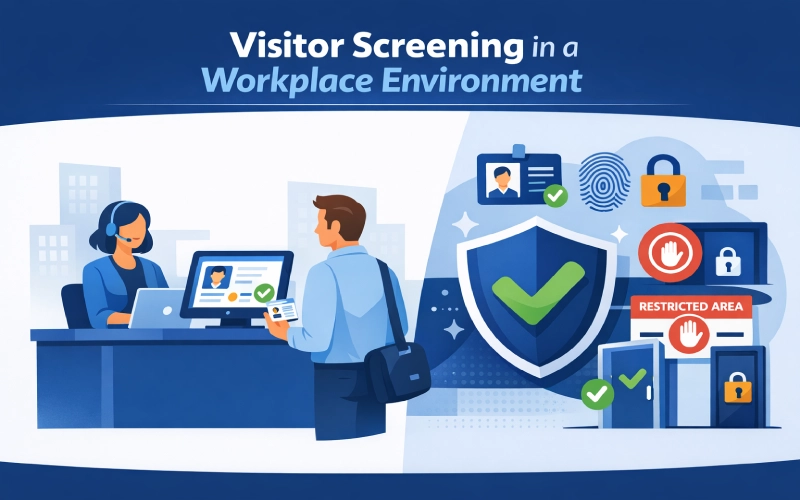
Basic visitor screening collects relevant data, validates identity, and confirms authorization. In contemporary settings, screening is part of a broader control framework that supports security, authorization, and transparency.
Screening should be applied regardless of who performs it or the location. Informal or undocumented screening increases risk. Formal screening ensures interactions follow decision logic and avoid bias.
Visitor Screening vs Visitor Check-In
The check-in and visitor screening processes serve different purposes. Check-in records arrival. Visitor screening qualifies each visitor for access.
The check-in process addresses the question of existence; it functions as a passive security control without screening. In contrast, screening addresses the question of permission. Professional workplaces distinguish these terms to ensure that access decisions are intentional, recorded, and thoroughly analyzed.
What does visitor screening aim to prevent?
The main goal of visitor screening is to block unauthorized access, including gaps in authorization and partial credentials. Visitors are directed only to approved spaces and hosts.
In addition to restricting physical access, screening directly reduces reputational, operational, and compliance threats. Verified visitors lower organizational risks, such as data theft or policy violations. The structured process ensures uniform entry standards, providing measurable protection benefits.
Why Visitor Screening Is Essential for Workplace Security and Compliance
Workplaces are exposed to multi-dimensional risks nowadays, which makes visitor screening a tool for safety. Entry is the intersection point between the threats of physical security, data protection requirements, and surveillance. Workplace security is knowing who is present, why they are there, and whether their access aligns with policy.
Organizations face audit, investigation, or incident exposure when screening is inconsistent or undocumented. Screening provides the structure needed to show due diligence and responsibility through transparency.
Security Risks of Unscreened or Poorly Screened Visitors
Unscreened visitors create uncertainty. This uncertainty undermines security and increases the need for reactive rather than preventive measures.
Blind spots may also occur due to poor screening. Incomplete visitor data makes the security teams blind to the identity of visitors who accessed the workplace and on what terms. This constrains incident response and post-event analysis.
Compliance and Audit Challenges Without Structured Screening
Evidence is needed for compliance, and unofficial screening procedures do not create credible records. Organisations would not be able to show that the access policies were applied uniformly without having structured procedures.
Moreover, Audits expose blind spots in which visitor approvals, identity checks, or access restrictions were inconsistently managed. The gaps will subject the organizations to more penalties, remedial expenses, and business disruptions.
How the Visitor Screening Process Works in Modern Workplaces
The visitor screening process works as a chain of commands. It assesses inputs, implements rules, and generates results. This workflow operates consistently across the area and visitor types to support the screening process in workplaces effectively.
With screening management, decisions are made using organizational criteria, such as visitor role, purpose, duration, and access level. Authorization is driven toward a clear objective.
Pre-Registration and Pre-Arrival Visitor Screening
Pre-registration screening shifts evaluation earlier. Organizations can assess eligibility, validate purpose, and flag exceptions in advance. Early screening minimizes congestion, manages risks proactively, and allows time for verification and approval before physical access requests.
Identity Verification and Access Control Screening
Identity verification for visitors ensures that the visitor’s requesting access matches the authorization granted by linking identity to permissions. Checking can be done using matching credentials or digital records. The integrity and accountability of access decisions will be denied without an identity verification process.
On-Site Screening During the Visitor Check-In Process
On-site screening during check-in validates alignment with pre-approved conditions. This final step confirms arrival details, host availability, and access scope.
On-site screening ensures current conditions match approvals and serves as the last control gate before authorization. Use visitor management software to Automate Visitor Screening
Types of Visitor Screening Methods Used Today
Visitor screening methods vary widely across organizations, enhancing traditional standards. The objective is the same, which is to measure and regulate visitor access, but the mechanisms to do so vary in reliability, scalability, and effectiveness.
These methods address common workplace challenges in visitor screening, such as increased visitor volume, regulatory expectations, and workplace complexity. Screening methods can be broadly classified by decision-making, recording, and implementation.
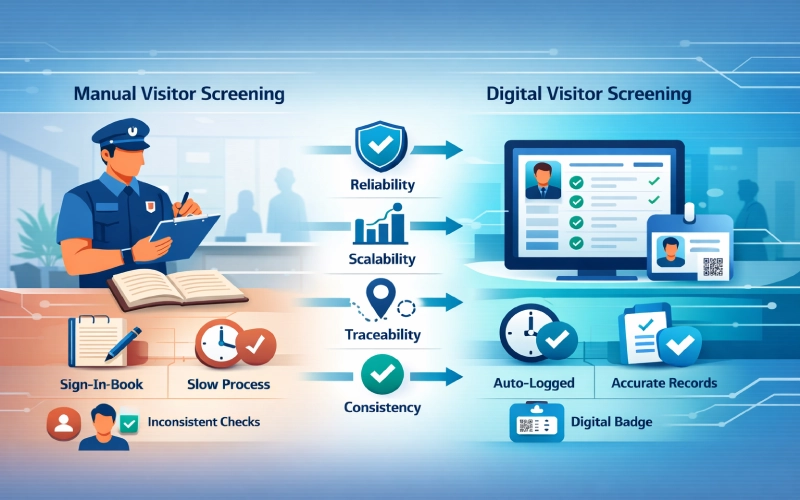
Manual Visitor Screening and Its Limitations
Manual screening relies on human assessment and unofficial procedures like handwritten logbooks, verbal confirmation, or visual checks. These might meet minimum access requirements but lack regular enforceability.
Manual methods depend on individual interpretation, not standardized criteria. Screening results vary by person, workload, or time, increasing risk and weakening security.
Record accuracy is another weakness. Paper records and notes are hard to audit, error-prone, and rarely integrated into other systems. In incidents, visitor activity cannot be quickly reconstructed.
Manual screening is not scalable. With more visitors, screening speeds up, becoming less preventive. These limitations explain office security gaps despite nominal practices.
Digital Visitor Screening Using a Visitor Management System
Digital visitor screening uses standardized criteria to replace human judgment. The screening is conducted according to the same parameters, and results are stored automatically. This strategy makes screening decisions consistent with organizational policies as opposed to individual choice.
Visitor management system screening also improves traceability. Every screening decision is recorded, time-stamped, and verifies accurate visitor information. This provides an efficient audit trail and accountability.
Digital screening allows organizations to go beyond reactive controls in terms of systems. Screening becomes proactive, measurable, and enforceable for modern workplace visitor screening at scale.
Common Challenges in Traditional Visitor Screening Approaches
Most organizations still use fragmented screening practices even though they are aware of security risks, and these risks would create systemic vulnerabilities later on.
The lack of intention does not lead to traditional screening challenges, but the lack of structure does. Screening outcomes vary widely, undermining the screening process in workplaces without centralized oversight.
Inconsistent Screening Across Teams and Locations
One of the most popular issues in the traditional setting is uneven screening. Various standards are used in varying offices, departments, or shifts. What is considered proper access in one place may be refused in another.
This inconsistency weakens office visitor security by creating risk exposure. It also makes compliance efforts more difficult because organizations will not be able to show consistency in the enforcement of access policies.
Hence, the result of screening would rely on the local practices and not the organizational guidelines without standardized processes. The decentralization creates uncertainty and operational risk.
Lack of Visibility, Logs, and Accountability
Security oversight must have visibility. The conventional screening procedures offer little information on who moved into the workplace, when, and on what basis. The logs are usually either incomplete or unavailable, or not linked with other records.
This invisibility compromises response to the incident and post-event analysis. In cases of questions, organizations find it difficult to confirm screening decisions or rebuild visitor movement.
The responsibility also becomes compromised. In the absence of clear records, one cannot tell whether there were screening policies followed or where failures have been experienced.
Difficulty Enforcing Security and Compliance Policies
Conventional modes of screening do not provide the controls that are required in order to safeguard that internal regulations or external laws are adhered to.
As a result, compliance visitor screening becomes reactive rather than preventive. The problems are detected during audits or incidents as opposed to being resolved by using systematic controls.
How Visitor Management Software Enables Effective Visitor Screening
Visitor screening is more effective when it is supported by system-level infrastructure. Visitor management software operationalizes screening logic rather than replacing it. Software can facilitate screening to operate at scale by integrating rules, approvals, and records in one system.
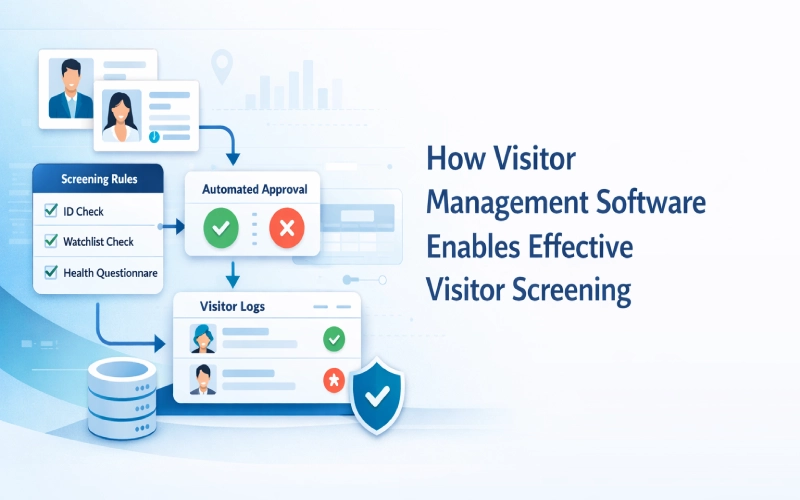
Screening becomes a controlled workflow because of the visitor management system. The system will make sure that the screening decisions are based on organizational policies and are implemented equally. Meanwhile, System VMS maintains consistency throughout the screening activities. As a result, these platforms could support governance without introducing manual complexity.
Automating Visitor Screening Rules and Approvals
Automation lessens uncertainties by adjusting according to screening rules in advance. Organizations can automate screening decisions based on visitor type, visitor’s visit purpose, or risk profile.
Automation is also faster in making decisions, and it still provides control over the process that aids in ensuring security and efficiency of operations. Therefore, automated approvals make sure that documented logic is used to make decisions on access, which promotes accountability.
Centralizing Visitor Information and Screening Records
Oversight is essential because of centralization. Organizations gain visibility into screening outcomes across locations and timeframes by consolidating visitor information using a single management system.
Audits, investigations, and continuous improvement are supported using centralized records. They also allow organizations to detect trends, weaknesses/loopholes, or anomalies in the screening activity. Automate Your Visitor Screening With a Digital Visitor Management System.
Visitor Screening as a Risk-Based Visitor Management Framework
Screening rules are no longer the same as workplaces continue to become more and more complicated. Various visitors come with different risks depending on the reason, time period, and accessibility needs. A risk-based visitor management approach recognizes this variability and applies screening controls.
Visitor screening becomes a decision model that assesses signal risk and aligns access outcomes with organizational tolerance levels. Hence, visitor management functions as a governance structure rather than a transactional process.
The risk-based screening will enhance protection of high-risk situations and minimise over-control of low-risk situations.
Screening Visitors Based on Role, Purpose, and Risk
The intensity of screening depends on the role the visitor plays, the visit intention, and the areas demanded. Another case scenario is a short-term guest who is in town for a meeting, who will have a different risk profile as compared to a contractor who needs to access regularly.
With these variables as the structure of screening, organizations have ensured that controls are made where they are most needed. This approach improves workplace visitor screening by focusing resources on higher-impact risks.
Clarity is also enhanced by screening decisions based on role and purpose. Hosts, security personnel, and visitors know the rationale behind some of these requirements, which makes them more consistent and compliant.
Aligning Visitor Screening With Workplace Policies
The policies specify tolerable risk. Effective visitor screening aligns operational decisions with documented workplace rules, safety standards, and regulatory obligations.
The screening logic is deemed to indicate policy intent, and enforcement is automatic instead of discretionary. This alignment supports compliance security by ensuring that access decisions are defensible and repeatable.
As well, policy-aligned screening makes governance easier. Policy modifications can be indicated in screening regulations, and no retraining or manual modification is needed.
Visitor Screening Use Cases in Modern Workplaces
There is a great variety of visitors that can be found at modern workplaces. The screening needs differ according to the environment, the function, and the sensitivity of access. The concept of common use cases helps us to understand how screening can be adapted to the context without contradicting the fundamental principles.
Each use case reinforces the importance of structured guest visitor screening and consistent workplace visitor screening practices.
Visitor Screening for Corporate Offices
Internal and external stakeholders are likely to be mixed in corporate offices. Frequency, purpose, and scope of access should be considered during screening without compromising a professional setting.
In these settings, screening supports office visitor security by ensuring that visitors are authorized, identifiable, and restricted to approved areas. Accountability is also assisted by structured screening, which identifies visitors and hosts and the visit purpose.
Inter-departmental consistency is essential. The screening processes should be used uniformly to prevent vulnerable areas in the company.
There are special zones, like conference rooms, that pose special screening issues. Visitors may access meeting room booking systems without requiring broader workplace access.
In these scenarios, the screening aims at confirming authorization to the particular places and dates. Integration with a visitor management system ensures that access aligns with scheduled usage and host availability.
This is a focused screening strategy to minimize unproductive limitations and control shared spaces.
Key Considerations When Implementing Visitor Screening Systems
Governance, privacy, and interoperability have to be thought out thoroughly when adopting the screening systems. This is not meant to complicate things but to provide sound controls that facilitate security and compliance goals.
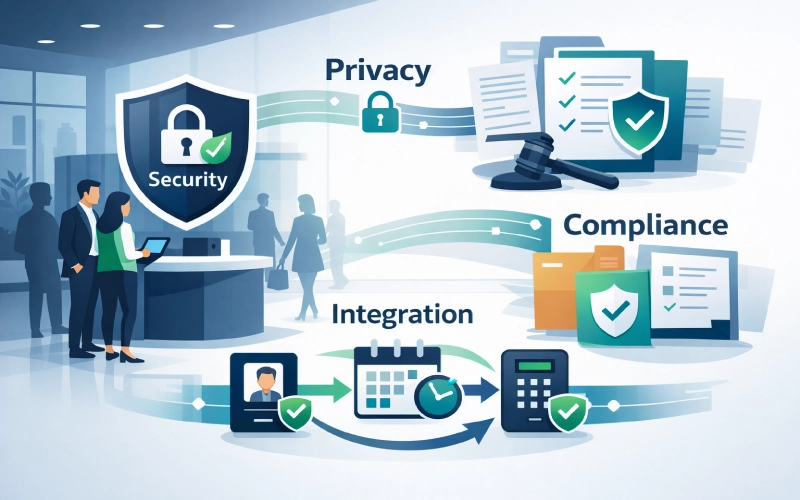
Visitor screening systems must operate within legal and organizational constraints while remaining adaptable to changing workplace needs. The choice of selection and design must be based on consistency and transparency.
Security, Privacy, and Compliance Requirements
Screening systems handle sensitive visitor information, making data protection a core concern. The collection, storage, and processing should be in line with the relevant privacy laws and organizational policies.
Data protection is not the only compliance aspect to consider. Audit preparedness should be supported by screening systems with proper records and policy implementation.
Balancing between security and privacy involves restricting purposes and controlled accessibility to screening data.
Integration With Existing Workplace Systems
Visitor screening with identity systems, access controls, and time scheduling systems makes them more effective and less duplicated.
When visitor screening software integrates smoothly with existing tools, organizations gain a unified view of access activity. This integration assists in governance through the coordination of screening choices into wider work systems. Stream your Visitor Screening with a Digital Visitor Management System
Conclusion: Building a Secure and Compliant Workplace With Visitor Screening
Visitor screening is no longer a peripheral administrative task. It functions as a system-level control that directly supports workplace security, operational governance, and regulatory compliance. The risks of unmanaged visitor access are proportional to the dynamism and accessibility of workplaces.
A visitor management system provides the infrastructure required to support this level of screening maturity. With centralization of rules, records, and decision logic, such systems enable screening to scale across teams and locations and have consistency. The system does not seek to substitute judgment; it is only to make sure that a judgment is implemented in a structure that is controlled and auditable.
When organizations adopt structured visitor screening software, they establish a foundation for resilient office visitor security and sustainable compliance. Screening is attainable, adhesive, and policy-oriented. This correspondence enhances the governance and minimizes operational and regulatory risk.
Therefore, visitor screening is more effective when it is established in the broader workplace ecosystem. As part of an integrated visitor management system, screening supports secure access, informed decision-making, and long-term accountability. Get Started With the best visitor management software for Secure Visitor Screening
FAQs: Visitor Screening
1. How is visitor screening different from access control systems?
Visitor screening determines whether access should be granted based on identity, purpose, and policy, while access control systems enforce how approved access is executed. Screening is the decision layer; access control is the execution layer.
2. Is visitor screening required even for short-term or low-risk visitors?
Yes. Screening establishes baseline accountability regardless of visit duration or perceived risk. Even low-risk visitors must be evaluated to ensure consistency, traceability, and policy adherence.
3. What information is typically required during a visitor screening process?
Visitor screening commonly requires identity details, visit purpose, host association, access scope, and visit duration. This information enables rule-based authorization and audit-ready records.
4. Can visitor screening be standardized across multiple office locations?
Yes. Standardization is achievable when screening rules, approval logic, and records are centralized. Without system-level infrastructure, location-based screening remains inconsistent and unreliable.
5. How does visitor screening support regulatory compliance and audits?
Visitor screening creates verifiable records that demonstrate uniform policy enforcement. These records serve as evidence during audits, investigations, and compliance assessments.
6. What risks remain if visitor screening is limited to manual processes?
Manual screening introduces inconsistency, incomplete records, and reliance on individual judgment. These gaps reduce accountability and increase exposure to security and compliance failures.
7. How does risk-based visitor screening improve workplace security?
Risk-based screening adjusts controls according to visitor role, purpose, and access needs. This approach concentrates security efforts where exposure is highest while avoiding unnecessary friction for low-risk visits.
8. When should organizations move from basic visitor screening to intelligent screening systems?
Organizations should transition when visitor volume increases, compliance requirements tighten, or multiple locations require consistent enforcement. Intelligent systems enable scalable, auditable, and policy-aligned screening decisions.


You must be logged in to post a comment.