

The modern workplace brings together humans, data, and resources in a complex ecosystem. Uncontrolled visitor access introduces major risks to both security and operations. That’s why a well-defined visitor policy establishes clear ground rules for safety and responsibility.
Organizations must consistently protect their people, property, and information. A company visitor policy acts as a vital framework for this protection. So instead of relying on ad-hoc receptions, it establishes a standardized, reliable process.
What are the core principles of effective visitor management? How can you adapt a foundational workplace visitor policy template to fit your organization? Our guide will help you focus on structure and strategy—are you ready to build a policy that works for your company, without the clutter of product promotion?
Contents
- 1 What Is a Workplace Visitor Policy?
- 2 Why Every Organization Needs a Visitor Policy
- 3 Workplace Security and Unauthorized Access Prevention
- 4 Workplace Visitor Policy Template (Editable Example)
- 5 How to Customize This Visitor Policy for Your Workplace
- 6 Common Mistakes in Workplace Visitor Policies
- 7 Visitor Policy vs Visitor Management System (What’s the Difference?)
- 8 How Visitor Management Software Supports Your Visitor Policy
- 9 Get Started with a Smarter Workplace Visitor Policy
- 10 FAQs About Workplace Visitor Policies
- 10.1 1. What should a basic visitor policy include?
- 10.2 2. Does a small office really need a formal visitor policy?
- 10.3 3. How will we manage deliveries and short visits?
- 10.4 4. Who is responsible for enforcing the visitor policy?
- 10.5 5. How frequently should we examine and update our visitor policy?
- 10.6 6. Will contractors be required to sign a different agreement from permanent guests?
- 10.7 7. What is the best way to handle visitor data privacy concerns?
- 10.8 8. Can we refuse entry to a visitor, and on what grounds?
What Is a Workplace Visitor Policy?
A workplace visitor policy is a formal document outlining rules for non-employee access. It defines who can enter your premises, under what conditions, and their expected conduct. This visitor policy serves as your official playbook for guest management.
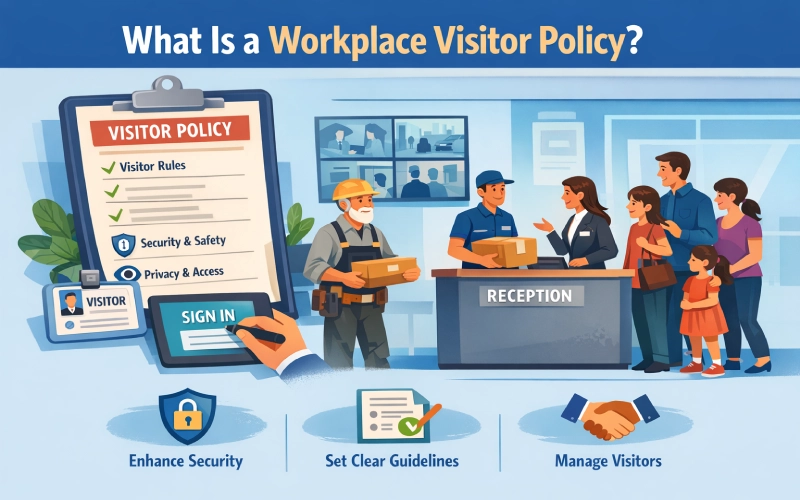
The organization’s policy applies to anyone who is not a direct team member. It also includes customers, contractors, delivery staff, and even family members. By creating the office visitor policy, the organization accounts for every guest in a consistent manner.
The policy is aimed at protecting security, privacy, and the functioning of the workplace. It lays down rules for both visitors and their team member hosts. Moreover, a strong company visitor policy lessens the risk and clarifies the expectations for all parties involved.
Why Every Organization Needs a Visitor Policy
Have you ever considered the risks of not having set rules to handle external office access? What happens when security is inconsistent or accountability fades? Could a formal visitor policy and procedures document be your answer to these vulnerabilities?
The policy transforms subjective judgment into objective, enforceable standards. This shields the company from legal, safety, and compliance consequences. Adopting visitor management guidelines fulfills a duty of care.
The absence of a policy invites confusion, conflict, and potential liability. Proactive creation demonstrates leadership and operational foresight. That said, these visitor management strategies are indispensable for modern business continuity.
A primary purpose is controlling physical access to your facilities. It prevents unauthorized individuals from freely entering sensitive areas. Your visitor policy is your first line of defense.
Security measures for visitors clearly delineate their allowed areas. This prevents tailgating and restricts movements to intended spaces. The policy cultivates security awareness among all participants.
The policy empowers employees to question or report unrecognized people confidently. This group vigilance dramatically reduces chances of theft or intrusion. This is why a defined visitor procedure makes security a shared responsibility.
Compliance, Safety, and Legal Accountability
Different sectors are required to keep stringent records for tracing the access of people to their facilities. A policy, therefore, guarantees that you are keeping the required visitor data ready for compliance inspections. This visitor management policy fulfills legal and regulatory record-keeping duties.
In an emergency, you must quickly account for every person on-site. Accurate visitor logs support fire drills or evacuation events. These visitor management guidelines demonstrate your commitment to duty of care and the safety of the occupants.
The policy distinctly outlines the legal liability that comes along with the visitors’ actions and the injuries that occur. It also shows the exercise of due diligence in the provision of a safe environment for everyone. Therefore, this framework plays an important role in risk management and legal protection.
Consistent Visitor Experience Across Locations
The policy synchronizes the welcome process for every guest. Regardless of location or timing, it always creates a professional first impression. Consistent visitor management strengthens and supports your brand image.
Visitors will know what to expect, which minimizes uncertainty. Staff can identify the guests they are receiving, which streamlines the process. A unified workplace visitor policy eliminates confusion and saves time.
Consistency is the magic word in the case of organizations with more than one office or site. The same high standards apply everywhere; thus, trust and reliability are built. The operational harmony is a strategic advantage.
Workplace Visitor Policy Template (Editable Example)
A strong workplace visitor policy template delivers a comprehensive framework. It covers all critical components without being overly prescriptive. You can use this outline as a robust, editable example.

This visitor policy example divides into sections for scope, procedures, and rules. Customize each segment as needed to suit your organization. Use this strong foundation to build your official document.
The template’s coherent structure and thorough content set its value. This document unites security, safety, experience, and accountability in one place. A good example combines thoroughness with flexibility.
Visitor Policy Scope and Applicability
This section defines where and when the policy applies. It covers all company-owned or leased properties, including parking areas. The company visitor policy must be explicit about its physical boundaries.
It covers operational hours along with protocols for after-hours access. The rules apply to employees, contractors, and temporary staff at every level. A clear office visitor policy leaves no uncertainty about its reach.
Visitor Types Covered (Guests, Contractors, Vendors)
Categorizing visitors allows for appropriate, tailored management procedures. Common types include clients, candidates, contractors, delivery personnel, and personal guests. Your guest visitor policy should define each group clearly.
Different visitor types receive different access privileges and escort requirements. You’ll need to distinguish between a single-time guest and a regular contractor. Properly classifying visitors makes office management secure and efficient.
Check-In, Identification, and Badge Requirements
All visitors must first report to a designated reception area. To enter, visitors present a valid photo ID for verification. This step ensures security and record accuracy.
At check-in, staff issue visitors a temporary, visible badge. This badge identifies them and often shows an expiration time. This visitor management procedure simplifies identification and access control.
Host Responsibilities and Visitor Conduct Rules
The team member is accountable for their guest’s conduct and safety. They must escort the visitor in restricted areas and during the entire visit. Clear visitor policy and procedures assign this direct responsibility to the host.
The policy establishes clear rules for visitor conduct on-site. Measures include maintaining confidentiality, following safety signs, and staying with their host at all times. Effective visitor management procedures are a guarantee against misconduct and accidents.
Data Privacy, Records, and Retention
Visitor data, such as name and company, includes personal information that requires protection. The policy explains how to collect, use, and store this data securely. A responsible visitor management policy upholds privacy regulations.
Define and enforce a strict retention period for visitor logs before securely destroying them. This balances security needs with privacy and compliance. Your visitor guidelines should address this data lifecycle clearly.
How to Customize This Visitor Policy for Your Workplace
The template becomes powerful only when you tailor it to your unique environment. Consider your company’s size, culture, and specific industry risks. Make your office guest policy reflect your company’s operational reality.
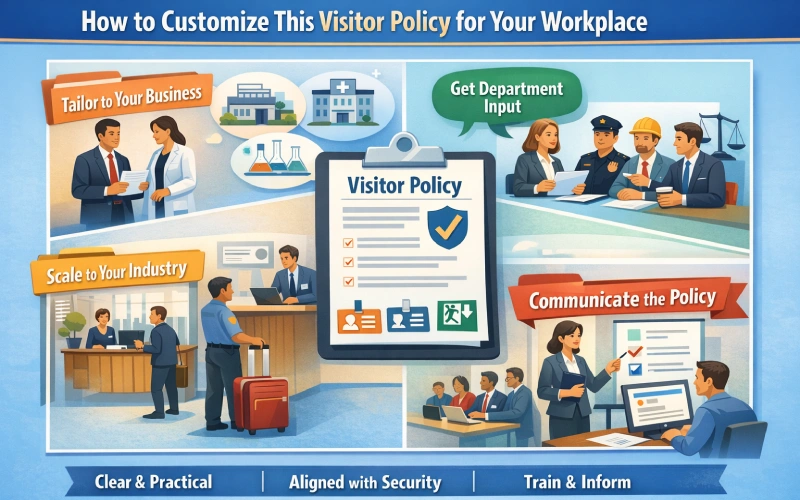
Engage security, HR, legal, and facilities departments in the policy review process. Their feedback identifies needed compliance or practicality changes. A policy tailored to your company gains wider acceptance and effectiveness.
Make the policy clear, enforceable, and consistent with your company’s values. Avoid complicated terms that employees may not understand. Your document should provide guidance that people can comprehend and use daily.
Adapting the Policy for Office Size and Industry
A small startup might just have a simple log-in sheet and a welcoming host. On the other hand, a large corporate campus could entail numerous detailed checkpoints and one-time visitor badge access. Your visitor management strategies must scale with your operational complexity.
A research lab has different security concerns compared to a retail showroom. Hospitals have to think about patients’ privacy and health regulations before anything else. Always include industry-specific risks in your policy’s basic requirements.
Aligning Visitor Policy with Internal Security Procedures
The visitor policy cannot operate in isolation, separated from other security regulations. It must reference and align with procedures for team member access and IT security. This creates a unified visitor management procedure ecosystem.
For example, visitor network access rules should mirror IT security policies. Emergency evacuation plans must include instructions for visitor assembly points. The plans for emergency evacuation must cover visitor assembly points along with guiding instructions. This alignment ensures security instructions for visitors are comprehensive and coherent.
Communicating Visitor Rules to Employees
A policy is useless if your team is unaware of it or its importance. Launch it through multiple channels like email, intranet, and team meetings. An email to employees about visitors can announce the policy and its key points.
Make the policy a part of the onboarding program for all newly hired employees. To maintain the effect, you can give the old employees short training or send reminders every now and then. Communication, even on a small scale, contributes to the embedding of the policy in your organization’s culture and routine.
Common Mistakes in Workplace Visitor Policies
A very common mistake is to draft a policy that is very vague and generalized. The use of words such as “everybody who comes to the office must check in” conveys a very unclear requirement that is not even enforceable. Effective visitor management regulations require writing in precise and practical terms.
Another error is that the policy is not updated after the major changes. Office relocations, new security systems, or regulatory changes all need policy updates. Visitor management strategies that are not changed quickly become outdated and ineffective.
Many policies also forget about the internal communication and training aspect. They put money into the policy document, but they do not put money into making sure that the employees understand it. This lack of team member understanding makes even the best-written policy totally useless when it comes to real-life application.
Visitor Policy vs Visitor Management System (What’s the Difference?)
Foundation is the difference between the written policy and the actual practice; that is the most important thing to comprehend. The visitor management policy is the official document containing your rules and procedures. It is the “what” and “why” of your visitor governance.
A visitor management system is the technological tool that enforces the policy. It handles the digital check-in, badge printing, notifications, and record-keeping. This system manages the “how” of your visitor management procedure.
You can have a policy without a software system, using manual methods. However, a system without a clear policy leads to inconsistent, ad-hoc use. The policy provides the strategic rules that the system operationally executes.
How Visitor Management Software Supports Your Visitor Policy
Modern software seamlessly enforces the rules outlined in your policy document. It automates the visitor entry procedure with digital logs and ID scanning. Thus, manual logging in paper logbooks is completely error-free.
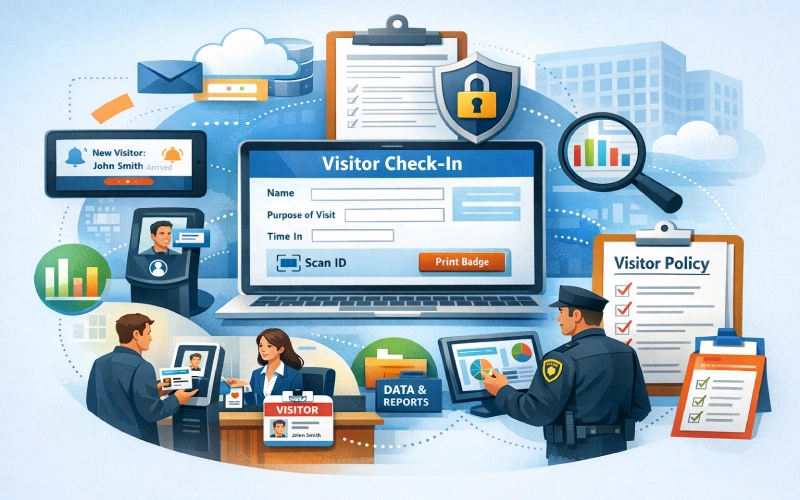
It streamlines the procedure that makes sure that every guest goes through the same process. The application is able to inform the hosts instantly and produce visitor badges that are compliant. All these functions allow the visitor management strategies to be executed in an effective manner.
The software also maintains secure, searchable records for compliance audits. It provides data on visitor volume, patterns, and host responsiveness. Transforming your visitor management process into a source of important operational insight
Get Started with a Smarter Workplace Visitor Policy
Start with an audit of your current practices regarding visitors and find out where the gaps are. The provided template framework can help you in drafting the first policy version. A more intuitive workplace visitor policy is just around the corner for you.
Team up with your coworkers, tailor the specifics, and promise to communicate clearly. This basic document will boost your security and professionalism. A robust visitor management policy is their journey, and it all starts with a step.
Consider how technology can later help you enforce and scale these rules. For now, establish the clear governance framework that every organization needs. This is how you build a safer, more accountable workplace today.
Ready to build your definitive visitor policy? Download our free, editable template to establish clarity, security, and professionalism from the ground up.
FAQs About Workplace Visitor Policies
1. What should a basic visitor policy include?
A basic policy needs scope, check-in rules, and host duties. It must define visitor types and set expectations clearly. Good visitor policy examples cover these five core elements.
2. Does a small office really need a formal visitor policy?
Yes, every organization benefits from defined visitor rules. It protects your assets and employees regardless of company size. An office visitor policy is essential for businesses of all scales.
3. How will we manage deliveries and short visits?
The approach your policy takes must set out the practices for all types of visitors. Delivery workers might be treated with a different, easier check-in procedure. A comprehensive guest visitor policy accounts for these frequent interactions.
4. Who is responsible for enforcing the visitor policy?
The reception staff are in charge of verifying check-ins, yet the responsibility is shared among all employees. The hosts are to a great extent responsible for making sure that their guests follow the rules. This is made clear by the visitor policy and procedures that explicitly define these roles.
5. How frequently should we examine and update our visitor policy?
Examine your policy at least once a year or after every major event. Also, updates are necessary after relocating the office or altering the security system. This practice ensures that your visitor management guidelines remain up-to-date and effective.
6. Will contractors be required to sign a different agreement from permanent guests?
Yes, contractors usually ask for a separate indemnity or confidentiality agreement. Their continuous presence brings different risks than those associated with a single guest visit. Your visitor policy should cover the additional protections that are required for these situations.
7. What is the best way to handle visitor data privacy concerns?
Be transparent by posting a privacy notice at your check-in point. Explain why data is collected, how it’s used, and your retention period. Adhering to these visitor management procedures builds trust and compliance.
8. Can we refuse entry to a visitor, and on what grounds?
Yes, your policy must affirm the right to refuse entry for safety. A visitor can be refused entry if they have no ID, behave in a way that affects others, or do not have an appointment. Security policy for visitors makes this necessary to some extent.


You must be logged in to post a comment.