

Remote working is no longer a temporary experiment; it is the operating reality for millions of professionals. Whether your team works fully distributed, follows a hybrid schedule, or uses flexible coworking spaces, the right remote working tools determine whether your workday flows or fractures. With an overwhelming number of tools available today, it can be difficult to find the best ones, especially if you are unfamiliar with working from home.
Here is a summary of our 5 best tools for remote work, all available for free.
Of course, we can’t go into all the details of what these fantastic apps can offer, but we hope this will give you an overview to help you choose the right applications for your business.
Why Remote Working Technology Matters More Than Ever
Over 34 million Americans now work fully or partially from home. The traditional office is no longer the default, yet the gap between a productive remote worker and a struggling one often comes down to one thing: the technology they use.
Without the built-in infrastructure of a physical office, remote workers face real challenges. Communication lapses, tool sprawl, isolation, inconsistent access to files, and security vulnerabilities all erode productivity. The right remote workforce technology closes those gaps.
The good news: in 2026, remote work software has matured significantly. You do not need dozens of apps. You need five categories of technology for remote work to work together seamlessly, and the right physical workspace to complement them.
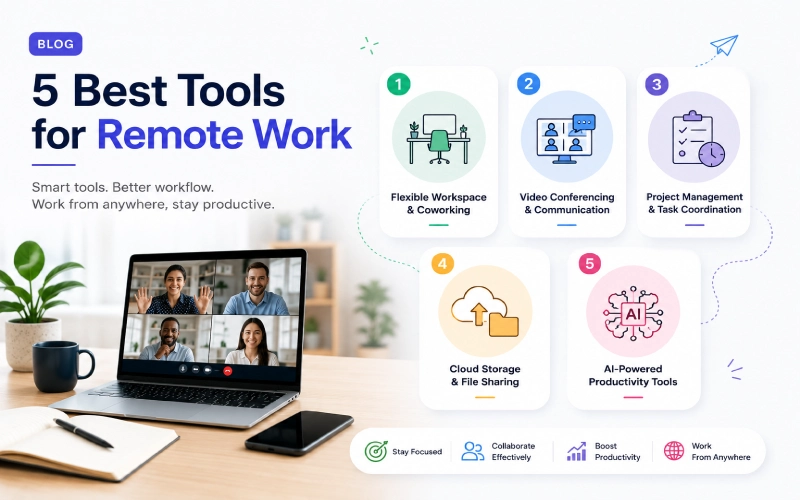
5 Best Tools for Remote Work
- Flexible Workspace and Coworking Solutions
- Video Conferencing and Communication Tools
- Project Management and Task Coordination Tools
- Cloud Storage and File Sharing Software
- AI-Powered Productivity Tools for Remote Work
What to Look for in Remote Work Software
Before diving into specific tools, here is what separates good remote working tools from great ones:
Integration capabilities: The best remote work tools connect with your existing stack. A project management tool that does not talk to your calendar wastes time. Look for platforms with native integrations or open APIs.
Asynchronous-first design: Not every remote team works the same hours. Tools built for async collaboration, threaded comments, recorded video messages, and shared documents serve distributed and time-zone-spread teams better than real-time-only platforms.
Security and access control: Remote teams access sensitive data from home networks, coffee shops, and coworking spaces. Your remote work software must include role-based permissions, two-factor authentication, and encrypted data transfer.
Ease of onboarding: A tool your team will not use is worthless. Prioritise platforms with intuitive interfaces that new team members can learn within a day.
Scalability: The remote work solutions you choose today should grow with your team. Check pricing tiers and feature availability as headcount scales.
1: Flexible Workspace and Coworking Solutions: Free and Premium Plans Compared
The best technology for remote work cannot replace the energy of a well-designed workspace. Remote working tools handle communication and collaboration, but where you physically work affects focus, professionalism, and well-being. Flexible workspace solutions bridge the gap between working from home and the traditional office.
Why remote teams need it
Home environments are not always conducive to productive remote work. Noise, lack of a dedicated desk, poor internet connectivity, or simply the need for a change of environment are real challenges for full-time remote workers.
Coworking spaces and flexible office solutions provide on-demand access to professional workspaces without the overhead of a permanent office lease.
What Othership Offers
Othership is a flexible workspace platform that gives remote workers and distributed teams access to coworking spaces, private day offices, meeting rooms, and café-style work environments across the UK, US, and Europe, bookable by the hour or day.
For remote workers, Othership solves the “where do I work today?” problem. For hybrid teams, it provides a flexible middle ground, access to professional meeting space when teams need to gather, without committing to a fixed office.
Othership is a flexible working platform consisting of 4 solutions.
-
- On demand provides instant access by the hour or day to workspaces, meeting rooms and private offices.
- Fixed workspace allows you to find the perfect office or coworking space tailored to your needs.
- Hybrid solutions lets HQs, regional offices and a network of on demand workspaces spaces become bookable and manageable in one place.
- Hybrid Workspace Management Software provides a streamlined, universal tool to manage all your workspaces solutions in one place and empower people to connect, collaborate & socialise.
For hybrid teams, pairing remote work software with access to flexible workspaces means the best of both worlds: the autonomy of remote work with access to professional space and in-person collaboration when it counts.
What to look for in a flexible workspace solution
Look for a workspace platform with a broad location network, easy booking tools accessible via mobile, reliable high-speed Wi-Fi at every venue, and clear pricing with no hidden fees. If your remote team occasionally needs to meet in person, prioritise platforms that offer private meeting rooms and event space alongside hot desks.
If you need some advice on hybrid work solutions, book a call with us and we help you find the best solution for your hybrid team!
2: Video Conferencing and Communication Tools
Reliable communication is the lifeblood of any remote team. Video conferencing tools recreate the face-to-face interaction that builds trust, accelerates decisions, and prevents miscommunication. Instant messaging platforms handle the in-between, the quick questions, status updates, and team banter that keep remote workers from feeling isolated.
Why remote teams need it
Email is too slow for real-time decisions. Video calls are too heavy for quick questions. Remote teams need a communication stack that covers both, synchronous for meetings, asynchronous for updates, and everything in between.
Top options to consider
Zoom
Undoubtedly, the most popular conference calling software is Zoom. On the free plan, Zoom offers unlimited calling time for 1-2-1 meetings, and 40 minutes for meetings with more than two participants (up to 100 participants). On a paid plan, you have access to unlimited time on group meetings, cloud storage for recordings, and optional add-ons (for example webinars).
Zoom also features a plugin that allows you to quickly schedule meetings directly from your Outlook meeting invitation!
Due to its recent rise in popularity, Zoom meetings have been subject to the phenomenon of “Zoombombing”, with meetings being joined by uninvited attendees.
Here are a few precautions you can take to prevent mishaps:
- Don’t share the meeting link publicly. Instead, use a system for attendees to register their interest before the event (for example, via Eventbrite). Then you can vet the list and choose with whom to share the link.
- Enable the Waiting Room feature so you have control over who is admitted into the meeting.
- Enable passwords on meetings. Without a password, it is possible to enter a meeting simply by knowing the meeting ID.
- Don’t share sensitive information via a Zoom call.
- Restrict screen sharing to the host only.
- Disable “join before host”.
Slack
Slack is a collaborative workspace hub. Within Slack, you can message co-workers, send files, screenshots and videos, make notes to yourself and more. Slack offers integration with many other applications, including Google Drive, Office 365, and Trello.
Reach different audiences via channels: for instance, you could create a separate channel for each project or department in your organisation, to ensure that your announcements go out to the right groups of people.
One limitation of the free plan is that it only stores up to 10k of message history, so once you reach this limit you will find that you no longer have access to older messages. Also, video calling is restricted to 1-2-1 meetings. However, with the paid versions you have access to an unlimited message archive, group calls and increased security.
Microsoft Teams
Microsoft Teams is the strongest option for organizations already embedded in the Microsoft 365 ecosystem. It combines chat, video, file sharing, and calendar in one platform, reducing the need for additional tools.

Loom
Loom solves a problem the others do not: replacing long meetings with short video messages. A remote team member can record a two-minute screen walkthrough and share it for async review, eliminating a scheduled call entirely. Loom is essential remote work software for distributed teams across time zones.
Loom is an easy-to-use video messaging app. It’s not like Zoom, Google Meet, or FaceTime because it is one-way, meaning you can only record yourself and your screen, and then send the final video to others via a shareable link.
Loom supports just about any platform. It has a website, Chrome extensions, desktop apps for Mac and Windows, and mobile apps for iOS and Android. The features offered by each app vary, however.
The iOS app, for example, cannot capture in screen and camera mode, while the Android app is unable to record in just camera mode. Remote professionals using these devices can also improve online privacy and secure work data by installing a trusted iOS VPN before joining public Wi-Fi networks. Furthermore, the Chrome extension is limited to recording only within Chrome, but an AI video maker can offer more flexibility across various platforms.

Google Drive
Google Drive is my favourite file management application. It’s a convenient way to quickly backup files and share documents with others.
Google Drive is also integrated with Docs, Sheets and Slides: the Google equivalent of Word, Excel and PowerPoint respectively. Create a document directly from Drive and you have instant access to all the main tools and features you’d expect from Microsoft Office, in the cloud.
Need to share large files? No more sending big attachments via email! Simply upload the file to Drive, generate a shareable link and send it to those who require access. You can control who has access to the file (specific people or anyone with the link) and what permissions they have (whether they can view, comment or edit).
The free version of Google Drive offers a generous 15GB of storage, but additional space of up to 30TB can be purchased for a monthly fee. Developers using Apple tools may also benefit from learning how to clear Xcode cache to free up space and keep their systems running smoothly.
Google Drive also features a desktop application which allows you to easily sync files on your computer with Drive, making backing up of files effortless. And if your work or studies involve a lot of writing, you can also streamline that process by using trusted platforms like EssayPro to get professional help with research papers or complex projects.
Google Meet
Google Meet integrates natively with Google Calendar and Google Workspace, making it the frictionless choice for teams already on Google’s productivity suite.
What to look for
Look for video conferencing tools with reliable HD quality, screen sharing, and recording. For messaging platforms, searchable history, threaded replies, and notification controls matter most. If your remote team spans multiple time zones, async-friendly features, such as voice messages, video clips, and threaded updates, are non-negotiable.
3: Project Management and Task Coordination Tools
Without a shared space to track tasks, deadlines, and responsibilities, remote teams drift. Project management software is the backbone of remote work productivity, replacing the whiteboard, the stand-up meeting, and the manager who used to walk the floor.
Why remote teams need it
When everyone works from a different location, work visibility disappears by default. Project management tools restore it. Team members see what they own, what is blocked, and what is due next without a meeting to communicate it.
Top options to consider
ClickUp
ClickUp is a cloud-based project management solution with a simple user interface that enables managing highly complex projects and organizations. Its uniqueness lies in integrating a large number of functions into a single platform. ClickUp pitches itself as “One app to replace them all. All of your work in one place: Tasks, Docs, Chat, Goals, & more”. The best bit is it proves to be fairly true. Imagine Trello meets Notion.

ClickUp is the most feature-dense remote project management platform available. It combines tasks, goals, time tracking, whiteboards, and docs inside a single workspace. Remote teams can assign tasks, set priorities, monitor workloads, and communicate through built-in chat, all without leaving the platform.
It offers team collaboration and shared task-setting functions. There are even status alerts and project updates to make sure people’s workflows are well aligned with goals. It’s also highly customisable with a huge number of templates available, meaning you can create new projects very quickly. One great example of this is their social media calendar, tailored to the social media planner.
Asana
Asana excels at managing complex, multi-step workflows. Its timeline view and workflow automation features are particularly strong for cross-functional remote teams who need structure without micromanagement.
Trello
Trello is the right choice for smaller remote teams who want a visual, Kanban-style board without complexity. Its drag-and-drop interface makes it fast to set up and easy to use from day one. Trello by Atlassian is a very handy project management tool. Create one board per project. Within each board, you can create lists (e.g. To Do, Doing, Done) and drag & drop cards (tasks) between the lists, great for tracking the progress of a project. Trello can be used for both team projects and individual projects.
With the free version you can have unlimited (personal) boards, lists and cards, so there are no restrictions on how much you can use the application.
The software can be extended with “Power-Ups” – adding extra functionality such as calendars, automation and integration with many other apps.
The paid versions allow you to attach files of up to 250MB, more Power-Ups, increased security and a greater level of automation.
Notion
Notion functions as a combined project management tool, team wiki, and knowledge base. For remote teams that need documentation and task management in one place, it is hard to beat.
What to look for
Choose a project management tool that offers multiple views (list, board, calendar, and timeline), clear task ownership, and integrations with your communication tools. If your remote team spans time zones, prioritise platforms that support async updates and comment threads on individual tasks.
4: Cloud Storage and File Sharing Software
Remote workers cannot walk to a colleague’s desk to grab a file. Cloud storage and file sharing software ensures that every document, presentation, spreadsheet, and asset is accessible from anywhere, on any device, at any time, with appropriate access controls.
Why remote teams need it
Without centralised file storage, remote teams scatter documents across email attachments, local drives, and personal cloud accounts. Version confusion, lost files, and security gaps follow. Cloud storage is the filing cabinet, shared drive, and document management system of the remote work setup.
Top options to consider
Google Workspace
Google Workspace (formerly G Suite) is the most popular cloud-based productivity and storage suite for remote teams. Google Drive, Docs, Sheets, and Slides enable real-time co-editing, meaning two remote team members can work on the same document simultaneously without versioning chaos.
Microsoft OneDrive
Microsoft OneDrive and the broader Microsoft 365 suite offer equivalent functionality for teams who prefer Microsoft’s environment. SharePoint enables more structured, enterprise-grade document management for larger remote organizations.
Dropbox
If you need a simple file hosting solution, Dropbox is for you. Like Google Drive, you can store and share your files with Dropbox. If you install the app on your computer you can access and sync your files directly from your desktop.
Dropbox includes a useful Transfer feature – which you can use to send large files of up to 100MB, without the recipient needing to have a Dropbox account.
Dropbox Basic (free) features 2GB of storage, but you can upgrade to one of the Business plans which provides from 5TB to unlimited storage, according to your needs.
What to look for
Prioritize cloud storage tools with version history (so you can recover previous document states), granular sharing permissions, and offline access. For remote teams handling sensitive client data, check for enterprise-grade security certifications such as SOC 2 and ISO 27001.
5: AI-Powered Productivity Tools for Remote Work
Artificial intelligence has moved from experiment to essential in remote work software. In 2026, AI tools for remote work handle everything from meeting summaries and email drafts to automated task assignment and focus tracking — freeing remote workers to spend time on high-value work instead of administrative overhead.
Why remote teams need it
Remote workers are often pulled in more directions than their in-office counterparts, managing their own schedules, documentation, communication, and deep work without the structure of a physical office. AI tools act as a productivity multiplier, handling repeatable tasks so remote workers can focus on creative and strategic output.
Top options to consider
Otter.ai
Otter.ai transcribes meetings in real time and produces searchable summaries. For remote teams on back-to-back calls, it eliminates the need for manual note-taking and ensures no decision or action item is lost.
ChatGPT and Claude
ChatGPT and Claude are general-purpose AI assistants that remote workers use to draft emails, summarise documents, write code, research topics, and prepare presentations. Having an AI assistant as part of your remote work tech stack compresses hours of writing and research into minutes.
Jasper AI
Jasper AI specialises in long-form content creation for remote marketing and communications teams who need to produce blog posts, ad copy, and social content at scale.
Grammarly
Grammarly sits in the background and improves written communication across email, Slack, Docs, and any other tool remote workers use to write. Clear, professional communication is more important in remote environments where tone can be misread.
QuillBot
QuillBot’s AI text generator is a practical tool for remote teams that need to create content quickly without compromising on clarity or quality. It helps users generate emails, reports, blog drafts, and ideas in seconds, making it especially useful for distributed teams working across different time zones.
The tool is designed to simplify the writing process by turning prompts into structured, easy-to-read content. Whether you are drafting internal communications or creating client-facing materials, it helps maintain a consistent, professional tone.
QuillBot AI Text Generator also works well for brainstorming and overcoming writer’s block, helping teams stay productive even under tight deadlines. Its straightforward interface ensures that anyone on the team can start using it without a steep learning curve.
Krisp.ai
Krisp.ai is an all-in-one AI meeting assistant designed to make remote collaboration smoother, smarter, and more productive. Powered by advanced on-device AI, it helps teams stay focused by handling everything from noise cancellation to meeting notes, so you can concentrate on the conversation rather than distractions.
Walter AI
Walter AI is designed for remote professionals who use AI to write faster but want their final output to appear authentic and credible. Instead of creating full drafts, it rewrites existing AI-generated content to read as if it were written by a human. That’s why it works well for teams handling blogs, product descriptions, internal documents, and client materials where quality and originality really matter.
Walter Writes AI includes a universal AI detection system that checks content across major AI detection tools to provide more reliable results. It not only preserves the voice and meaning of the text but also improves its natural rhythm and burstiness, so the write-up sounds more like a real person, as highlighted in Walter’s review discussions on Reddit. With support for 80+ languages, it is highly useful for teams working remotely across different regions and languages.
Key Features: AI Noise Cancellation, Live Transcription, AI Meeting Notes & Summaries, Recording, On-Device Processing & Security, Seamless Integrations.
Just Done
For remote professionals who spend a significant portion of their day writing, researching, or creating content, AI-powered productivity tools can eliminate repetitive work and improve output quality. One option worth considering is JustDone, an AI assistant designed to help remote workers draft emails, generate reports, summarize documents, rewrite content for different audiences, and perform AI detection checks when reviewing content from multiple sources. Instead of switching between multiple writing and editing tools, remote teams can use a single platform to streamline content creation, making collaboration faster and reducing the time spent on administrative tasks. As AI becomes a standard part of remote work workflows, tools like JustDone can help teams stay productive without sacrificing quality.
So that was a quick rundown of our chosen tools, we hope you found it useful. You can also check out our article “An essential tools list for the broke SEO specialist“.
What to look for
The best AI tools for remote work integrate with the platforms you already use. A meeting transcription tool that does not connect to Zoom or Google Meet adds friction instead of removing it. Look for AI tools with data privacy controls, especially if your remote team handles confidential client or business information.
Some Extras to Check Out

Figma
Figma is a web-based app for graphic design and user interface design. Figma, owned by Adobe, handles all kinds of graphic design work, from wireframing websites to designing mobile app interfaces to prototyping designs to crafting social media posts, and everything in between.
Figma works directly on your browser and has a powerful community and resource set, which means designers who don’t even use Figma still navigate the site regularly. Another reason designers love Figma is its incredible free plan, especially for individual designers. Lastly, Figma also offers Figjam, an easy-to-use whiteboarding tool for early design phases.
RemotePeople

RemotePeople is a global Employer of Record (EOR) and hiring platform that helps companies hire full-time employees or contractors in 150+ countries without setting up local entities.
Unlike traditional EORs that stop at payroll and compliance, RemotePeople also offers in-house recruiting. They handle legal infrastructure, taxes, and statutory benefits, and can actively source and vet international talent for your team.
Pricing is simple and transparent: flat rates starting at $199 per employee per month, with no hidden fees as you scale.
RemotePeople can compliantly onboard new hires in as little as 48 hours. You also get a dedicated account manager and optional services like visa support and help with entity setup.
For startups and mid-market companies that want to grow a remote workforce quickly and compliantly, RemotePeople is an all-in-one partner – from finding talent to getting them onboarded and paid correctly worldwide.
Remofirst
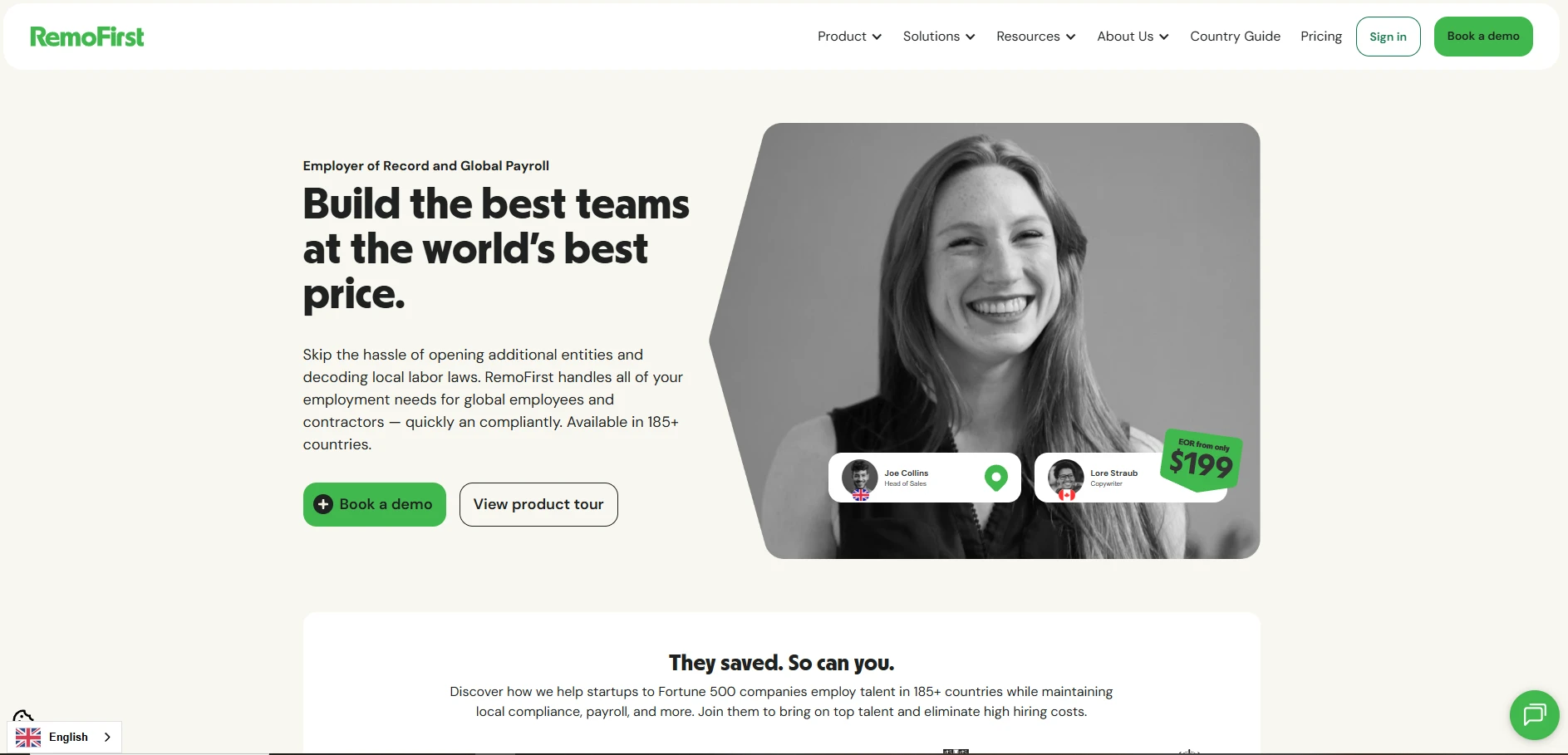
Remofirst is a global expansion employer of record (EOR) platform that enables businesses to legally hire full-time employees or contractors in over 180 countries without setting up local entities. As the legal employer, Remofirst handles everything from compliant contracts and payroll processing to taxes and benefits administration, while you maintain full control over day-to-day work and team management. It’s a powerful solution for companies looking to scale globally without the usual operational and legal headaches.
The platform is especially useful for remote-first or hybrid organizations building distributed teams. It’s also a practical choice for companies looking to scale faster and hire remote developers across different regions while staying fully compliant. With a user-friendly dashboard, flat-rate pricing, and dedicated support, Remofirst simplifies cross-border hiring and reduces time-to-onboard. Whether you’re a startup expanding into new markets or an enterprise managing talent worldwide, Remofirst helps you stay compliant and competitive as a global employer.
Brosix
Brosix is a secure, full-featured instant messaging platform designed for organizational collaboration. With Brosix, you can chat with teammates, share files and screenshots, make voice and video calls, and collaborate with tools like screen sharing and a virtual whiteboard. Brosix prioritizes privacy with full encryption and gives administrators granular control over user access and branding.
Reach different teams or departments using dedicated channels, ensuring that messages and announcements are targeted to the right groups within your organization. Brosix is highly scalable and offers both free and paid plans to accommodate businesses of all sizes.
The free personal version allows small teams to get started, while paid business plans provide advanced features like comprehensive compliance logging, expanded collaboration tools, and greater administrative control. Premium plans unlock the full suite of features for maximum productivity and security.
How to Choose the Right Remote Work Technology Stack
Building a remote work tech stack is not about having the most tools; it is about having the right ones. Here is a practical framework for choosing remote work software that fits your team:
Start with communication: Before anything else, your remote team needs a reliable way to talk. Choose one video conferencing tool and one instant messaging platform, then commit to them. Tool proliferation is the enemy of remote team cohesion.
Add project management second: Once communication is sorted, add a project management tool that matches your team’s working style. Visual thinkers do well with Kanban boards; structured teams often prefer timeline views.
Layer in file storage: If you are not already using Google Workspace or Microsoft 365, adopt one. Centralized, cloud-based file storage removes one of the most common remote work friction points immediately.
Introduce AI tools incrementally: AI productivity tools have the highest impact when introduced one at a time. Start with meeting transcription (saves time on every call), then add a writing assistant, then explore task automation.
Solve the workspace problem proactively. Do not wait for team members to complain about working from home before addressing the physical workspace. A flexible coworking membership through a platform like Othership gives your remote team options before the environment becomes a drag on productivity.
Final Thoughts
The best remote working tools in 2026 share a common quality: they reduce friction. They make communication faster, collaboration easier, files more accessible, and focus more achievable. The remote workers and distributed teams who thrive are not those with the longest list of apps; they are the ones who have chosen a small set of excellent tools and mastered them.
For remote work software, think in categories: flexible workspace, project management, communication, cloud storage, and AI productivity. Cover each well, ensure your tools integrate with each other, and give your team access to a professional workspace when they need it.
If you are building or refining your remote work setup, start with Othership. Browse our network of coworking spaces, private offices, and meeting rooms across the UK and beyond, and find the workspace that makes your best work possible.
Find your perfect remote workspace →
Happy remote working!


